Also on LinkedIn · X · Threads | In Korean on Brunch | In Japanese on note | Get relevant opportunities first

This week Angel Investment Network published its 2026 investor survey. 54% of angels said they had walked away from a startup because the AI looked bolted on for hype. The fastest reasons to say no were a founder who could not explain the problem, and no evidence of demand.
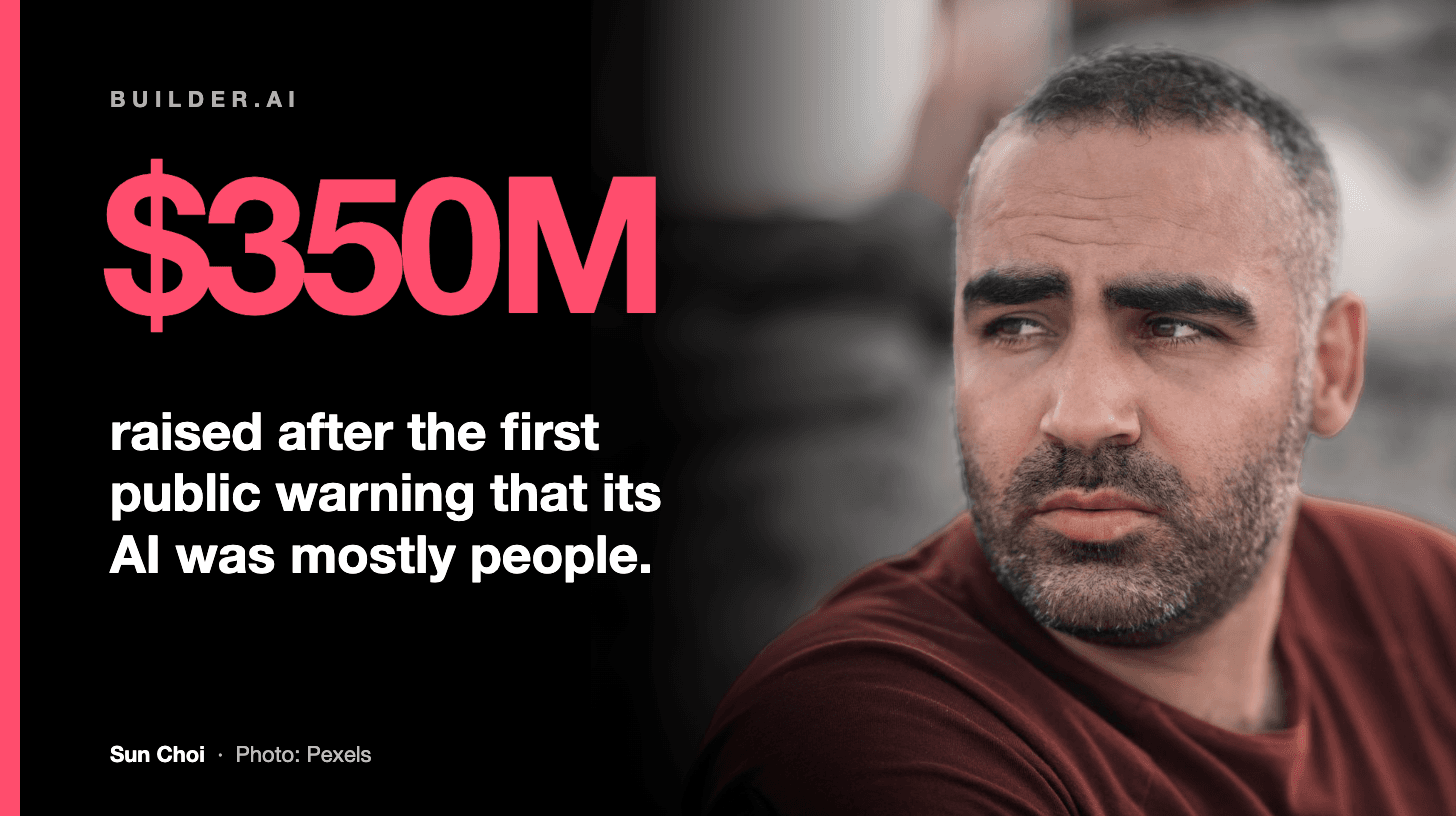
Investors are watching for it now. They were not always. Builder.ai went bust in May 2025, and the first public warning had come six years earlier.
In August 2019, The Wall Street Journal reported, as The Next Web summarized it, that a startup called Engineer.ai, which said artificial intelligence built its customers' apps, relied mostly on human engineers to write the code. The paper cited current and former employees and internal documents.
The company renamed itself Builder.ai and kept raising.
In 2022 it raised $100 million. In May 2023 it raised $250 million more, taking the total past $450 million. Around the same time, one of the largest technology companies in the world took a stake and planned to build the company's AI assistant into its own software.
In May 2025, after an internal investigation into its sales, Builder.ai entered insolvency.

Two different problems
These are two different stories.
The 2019 report was about the product. Was AI doing the work, or people? The 2025 collapse was about the numbers. Were the sales real?
I do not know what was in the investors' diligence files. Maybe they read the 2019 story and got an answer that satisfied them.
Very experienced people backed this company.
The one thing that made Builder.ai an AI company was questioned in public. The biggest round closed nearly 4 years after that. 2 years later, the company's own investigation found problems with its reported sales.
If a label can carry an open question that long, past people that good, it is stronger than we like to admit. And it works on all of us, me included.
The money was far from the floor
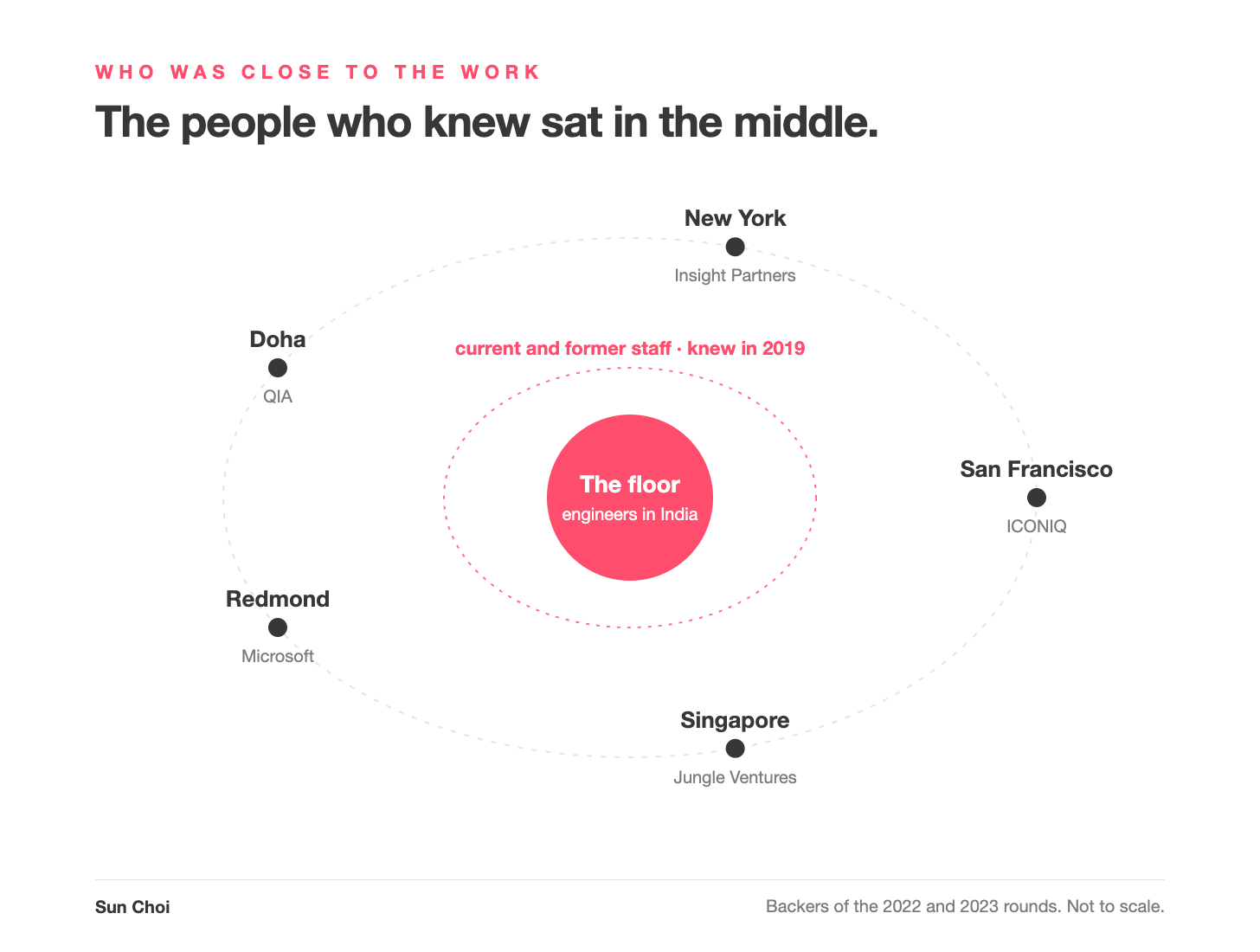
Much of the work Builder.ai's AI was supposed to do was done by engineers in India. The 2019 story came from current and former employees. The money came from Doha, New York, San Francisco, Singapore and Redmond. Qatar's sovereign wealth fund led the largest round, with Insight Partners, ICONIQ and Jungle Ventures alongside.
The people closest to the work knew in 2019. Most of the money on that cap table sat far from it.
Far from the work, you cannot walk the floor, call a former engineer, or read the local press. You lean on the label, and on who else is in the round. The farther you sit from the people doing the work, the heavier the label gets.
That gap is most of my job. I sit between money in one country and companies in another. The useful part is being close enough to the work to check what the label says.
AI is the new Stanford
Last week I wrote about being asked, in a final interview, why I did not go to Stanford. The school name lets an investor borrow someone else's judgment. If it goes wrong, it is hard to be blamed.
"AI" does the same job.
It is hard to be blamed for backing the AI company everyone else backed. It is easy to be blamed for missing it.
Some of the money in AI is a real bet on a real market. Fine. A bet on a category is still a different thing from a check on a company.
A school name stands in for checking a person. "AI" stands in for checking a product.
The label cuts both ways
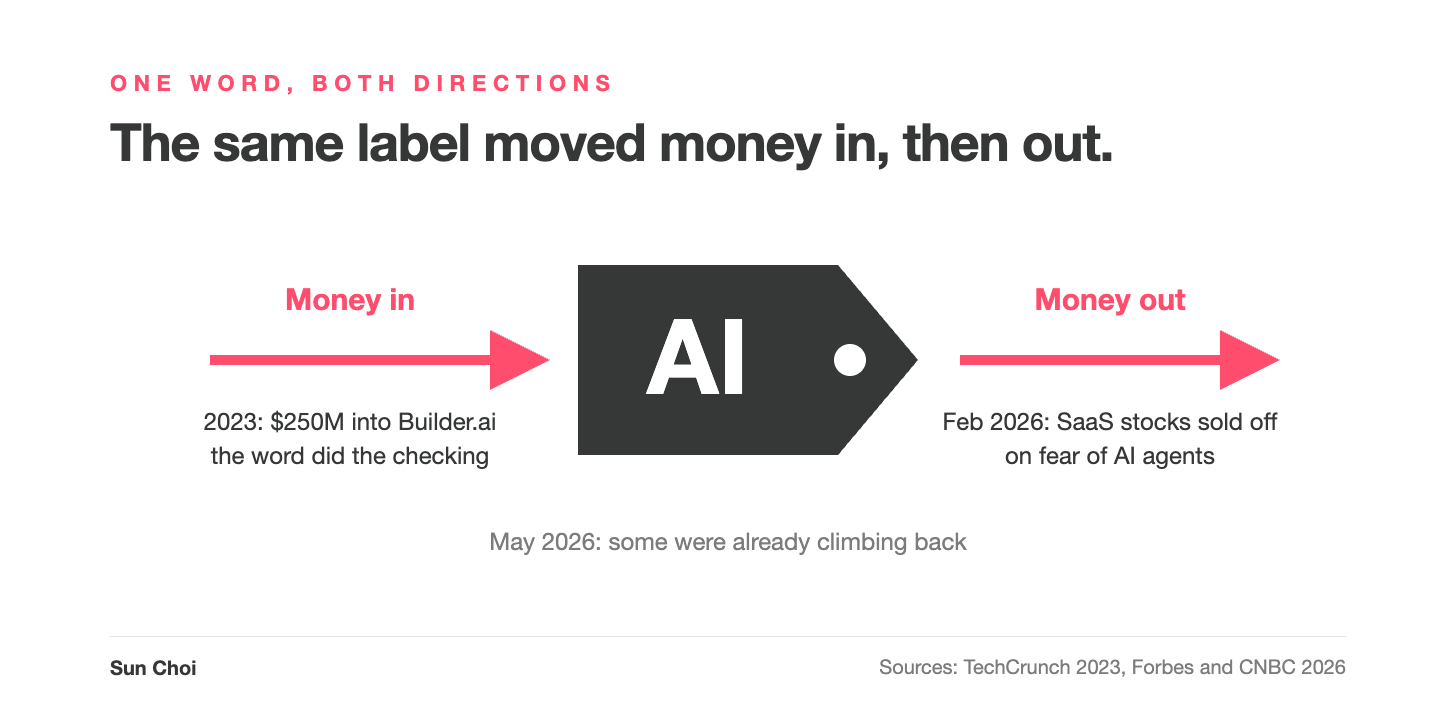
This year the same word moved money in the other direction. In February, after new AI agent tools came out, investors decided software companies were finished and listed SaaS stocks fell hard. By May, some were already climbing back.
I build with these tools every week. They are very good at making something that looks finished. What they do not bring is the rest: knowing what the customer actually needs, knowing the industry, knowing enough about building to see where it will break. That still has to come from the person using them.
Give the same hammer to a 10-year-old and to a carpenter. You do not get the same house.
AI can change a lot. How much depends on whose hand it is in. So the first thing I look at in an AI company is not the AI.
What I ask an AI company
I see a lot of decks that say AI. Many of them are not solving anything for the customer. They just say AI.
The general questions still apply. Who uses it, and do they come back. Who on the team has worked in the industry itself, factories or clinics or ports, beyond AI in general.
But for an AI company I care most about three things.
What the words mean. A founder once pitched me "AI for the physical world." What does that mean? It could be a smart city. It could be self-driving cars. It could be anything. A founder who has built the thing tells you which model, trained on what data. Vague words usually sit on top of vague work.
Where it breaks. A founder who has run the product with real customers can tell you the last time it failed and what they changed. A founder who only has a demo has never seen it fail, so the question gets a confident answer and nothing in it.
Where the data comes from. Most AI products are only as good as the data they can get, and the data usually belongs to someone else. A hospital, a port, a factory. Last month I told a team at the idea stage, with no connections to the data it needed, that it should change the idea. If you cannot get the data, the model is a promise.
What a demo hides
In 2019, faking an AI product took a team of engineers working behind the curtain. That was expensive, and it is why the story could be caught.
Today a working screen takes me an afternoon. I am not a developer, and I now build most of the software I run my work on with AI. I tell non-technical founders to do the same, treating the AI like a CTO and moving one step at a time.
It also breaks quietly. In September a tool I built cut a 4,588-word newsletter piece down to 1,615. Six sections and every source were gone. There was no error. It looked finished. Another tool that collected my meeting transcripts was losing some of them at 3 different points. Nothing said so. It came out only when someone went looking for one that should have been there.
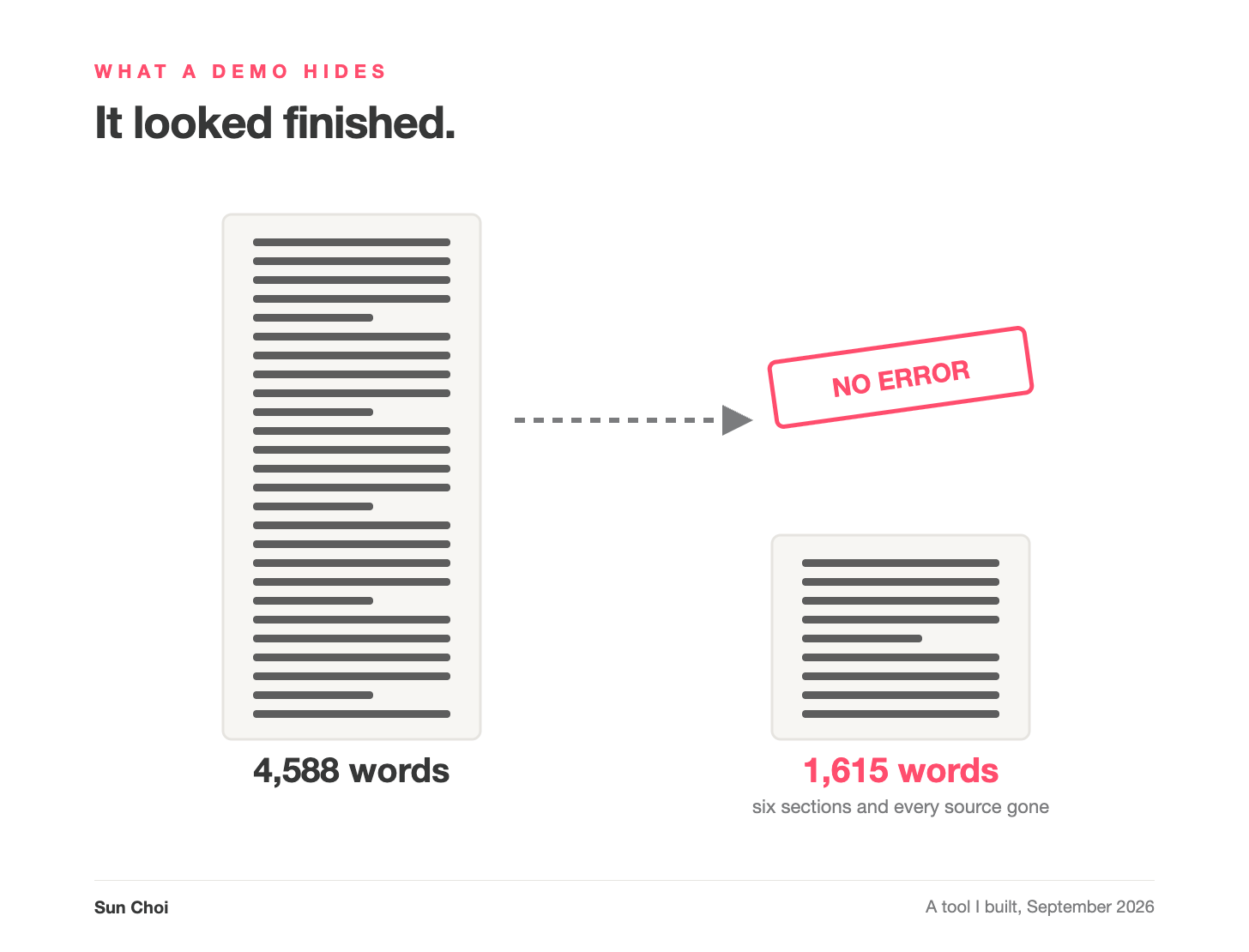
Neither problem would have shown up in a demo. Both showed up because someone used the thing every day.
In 2019 a working demo at least meant someone had put in real work, honest or not. In 2026 it means someone had a free weekend. The next Builder.ai probably will not be fake AI. It will be real AI with nothing underneath. A thin layer on someone else's model, no customers who come back, no data of its own. It will demo beautifully.
That is why the old questions matter more now, not less. Who uses it. Where it breaks. Whose data it runs on.
The label is not the problem
Builder.ai is an extreme case. Most founders who say AI are building something real. The label is usually right, so people stop checking it. And when it is wrong, the first warning is often already public, waiting for someone to read it.
The word AI on a deck is a claim. It is not an answer.
In this newsletter I write down the things I got wrong, or was on the wrong end of, in how capital picks people across borders.
Founders and investors working across borders: tell me which side you are on, and I will reach out first when a program or a seat fits.