From first commit to first close.
We back founders with hands-on acceleration, a global network, and the corporate and capital connections to scale beyond their home market.
- 27
- programs run
- 28
- companies backed
- 492
- decks in the library
Why 2080 for startups
Most founders in our markets are not short of ambition, they are short of the first institutional customer and the first cheque from someone who understands their market. That is the gap our programs are built around. We have run 27 of them with governments, banks and corporates across seven countries, which means the introductions we make come with the weight of the institution behind them rather than a warm email.
What you get
- 01
A program, not a workshop
Twelve weeks built around the things that actually gate your launch: MVP validation, first paying customers, the licence path if you need one, and being ready for the round after this one.
- 02
First cheque and follow-on
We invest through our own vehicles and open the syndicate to co-investors who already underwrite emerging-market risk, so the round after ours is not starting from zero.
- 03
Corporate and public pilots
Our partners include the institutions you have to sell to. Introductions run as scoped pilots with an owner and a deadline, not as a coffee.
- 04
A second market
Soft landing, market-entry support and local operators in Korea, Japan, the Gulf, Georgia and Southeast Asia, so expansion is not a cold start.
- 05
The founder stack
Perks, credits and tooling that cut your burn, plus a library of 492 decks that actually raised.
From the newsletter

Five places cross-border capital work quietly breaks, all for the same reason: someone skipped the five-second check.
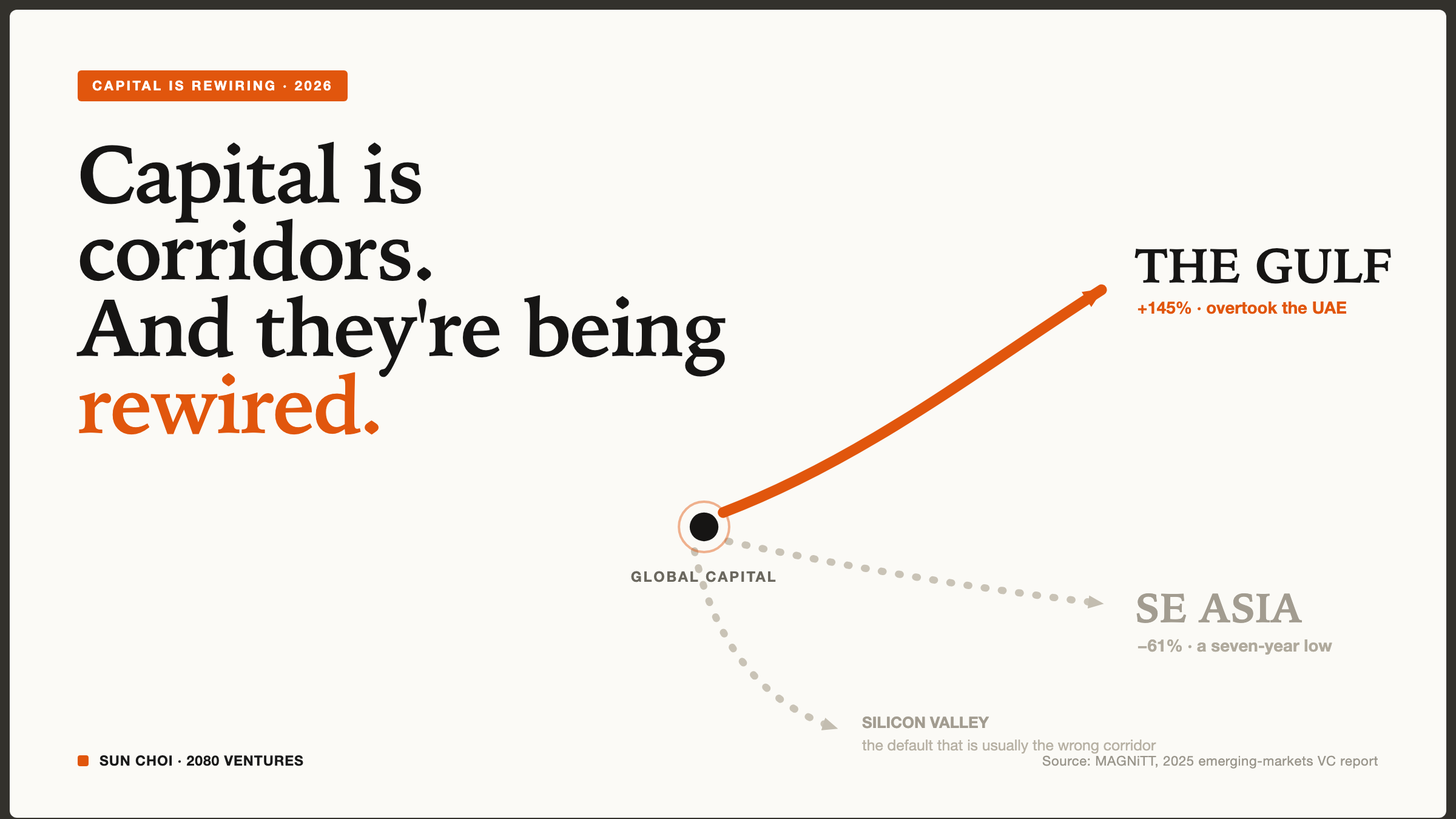
Money does not move like one global pool. It moves in corridors, each with its own mandate and direction.
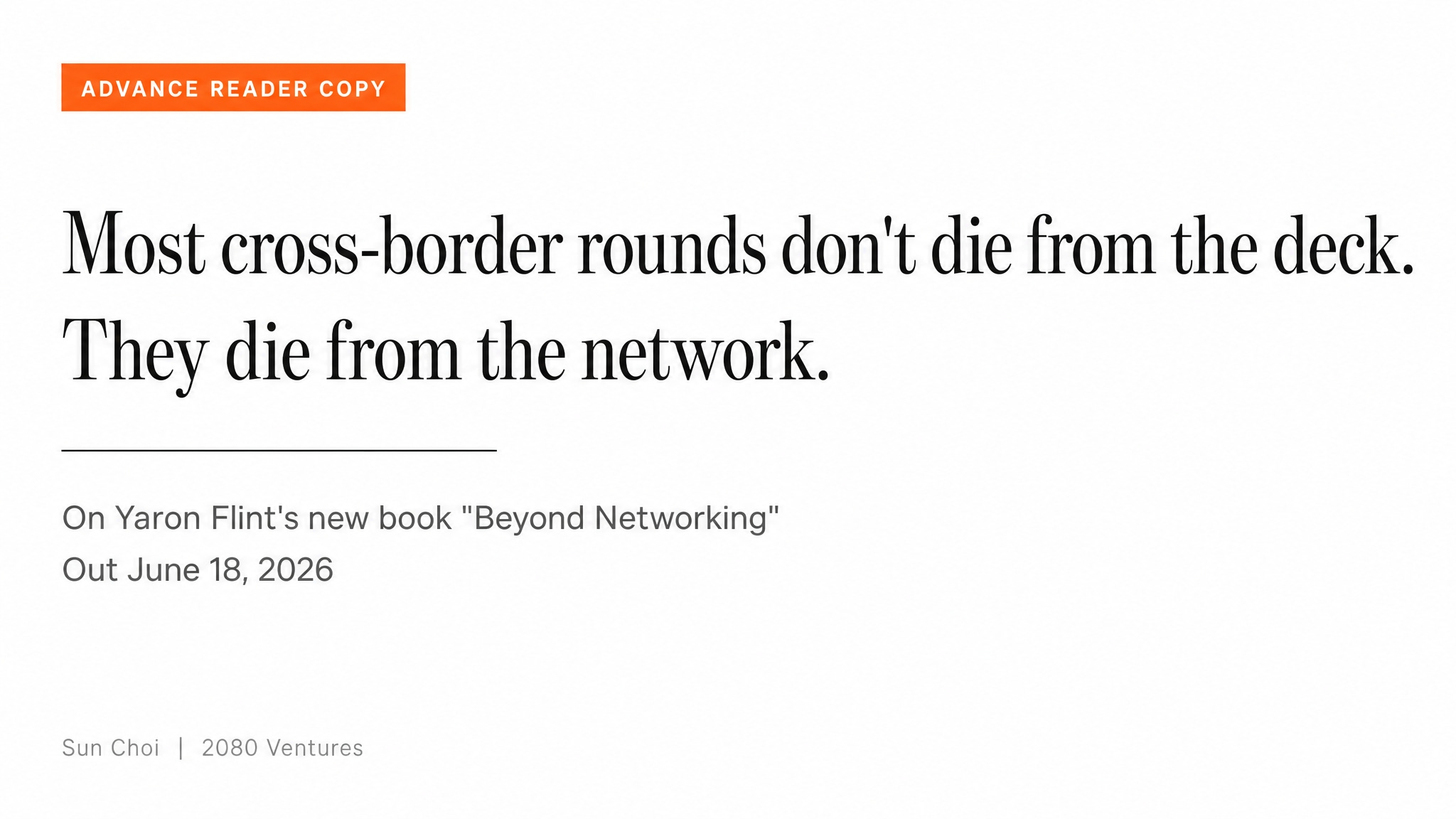
An advance copy of Yaron Flint's new book gave me language for a problem I see every week: founders trying to build Stage 3 relationships with a Stage 0 network.
Companies we have backed








Open right now
Reading
Median seed in our library of 492 funded decks is $750K, and the seed range spans 3,000x. What the data says about naming your number.
Across 27 delivered programs, only seven were accelerators. Eleven were market entry, and government agencies commissioned 16 of them.
More tools are built for portfolio monitoring than for deal sourcing, and two-thirds of vendors will not tell you what their product connects to.