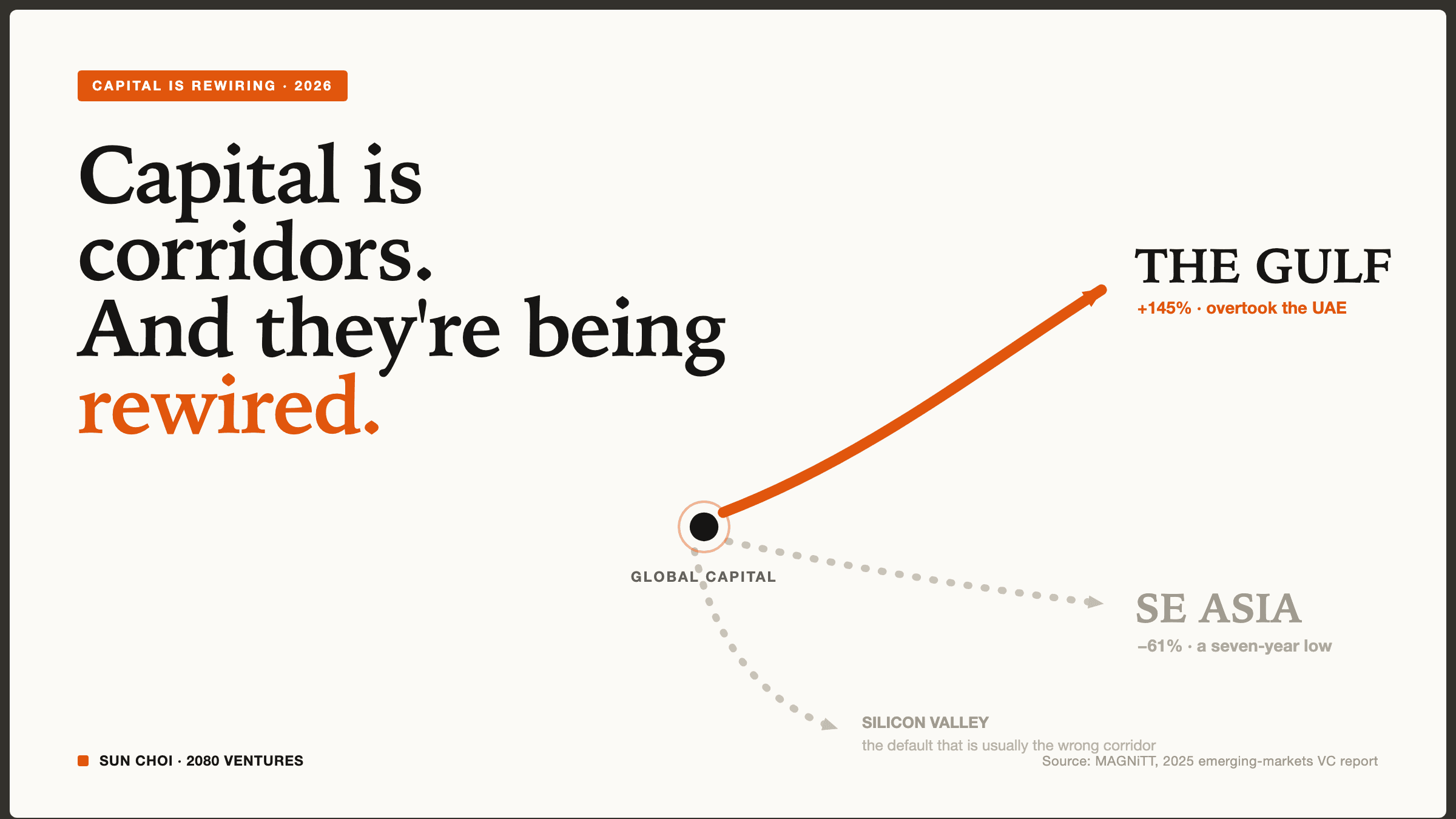
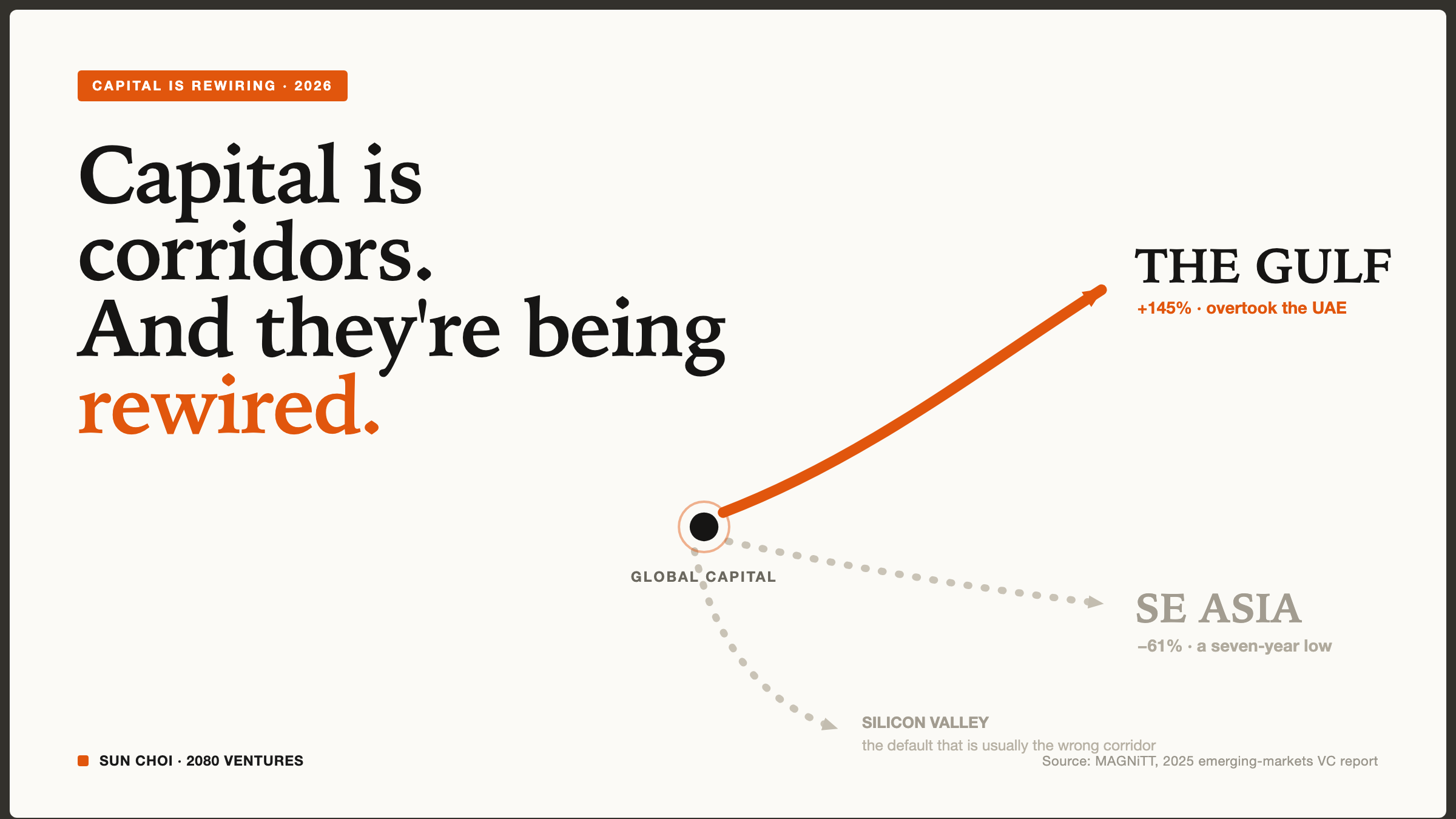
I’ve spent years watching cross-border rounds die. Not from the deck. From the corridor.
Everyone in emerging markets hears the same advice: go global. In practice, “go global” almost always means “go to the US.” Fly to San Francisco, raise from a name-brand fund, and you’ve arrived.
For most founders that is the wrong corridor. And the data now shows the smart capital already knows it.
What is actually moving in 2026
Hillhouse, one of Asia’s largest investors, is raising up to 8 billion dollars for new funds by tapping Middle Eastern backers, while separately ramping to as much as 2 billion dollars a year of investment into Japan. Chinese capital is rewiring its own corridor: raising from the Gulf, deploying into Japan.
Saudi Arabia just overtook the UAE as the region’s largest venture market, roughly 1.7 billion dollars and up about 145 percent in a year, per MAGNiTT. The Gulf’s center of gravity moved.
Saudi Arabia also overtook Singapore as the single most active emerging market, while Southeast Asia posted its weakest early-stage quarter in seven years, per MAGNiTT. A ranking most Western LPs still take for granted just inverted.
None of this is secret. It is in the reports. What is missing is anyone connecting it.
Capital moves in corridors
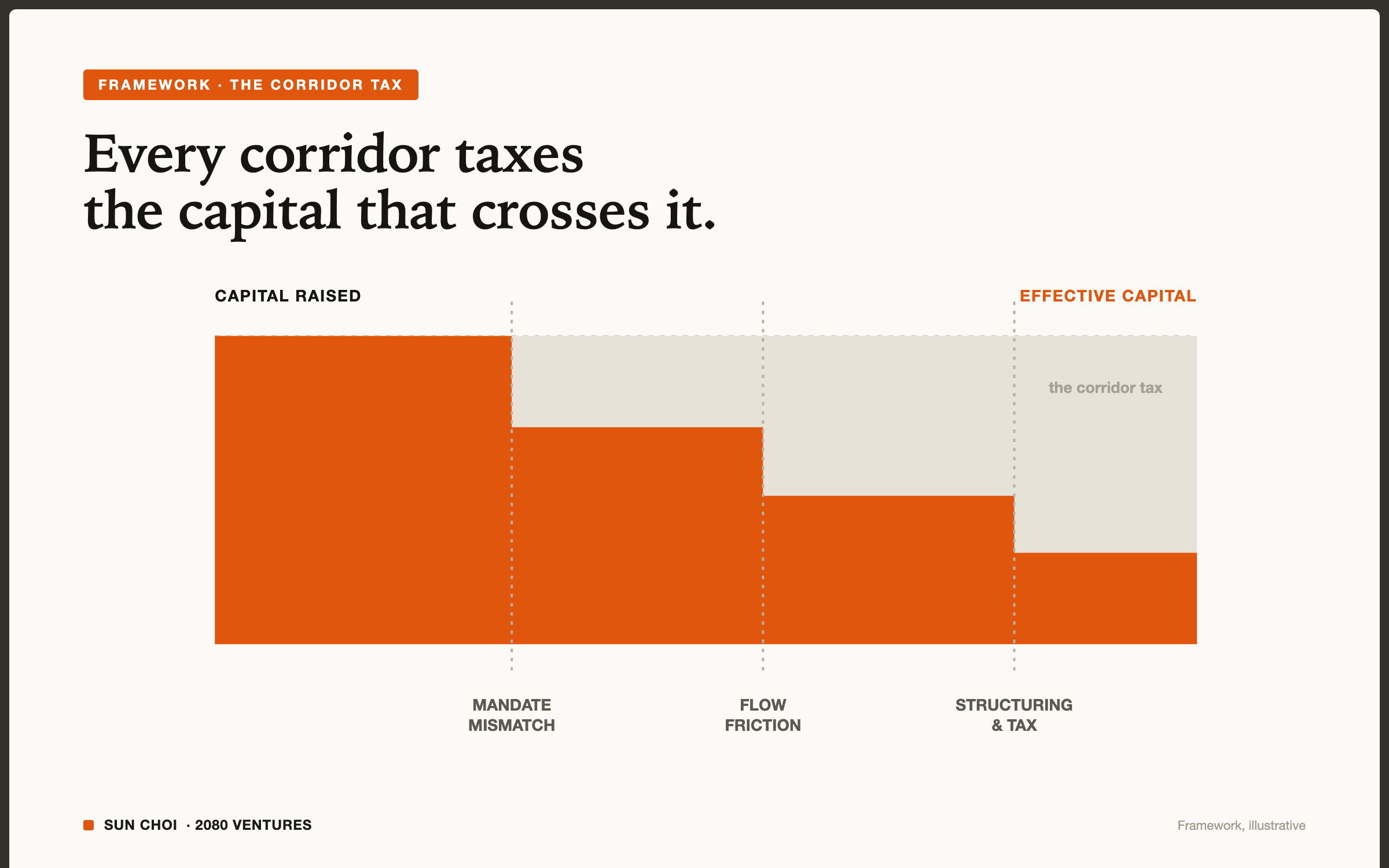
Every influential voice I read is stuck inside one market. The best Korean voices write about Korea and the US. The best Japanese voices write about Japan. The Gulf voices write about the Gulf. They are excellent, and they are also blind to the thing that decides outcomes now: capital does not behave like one global pool. It behaves like corridors, each with its own mandate, gatekeepers, and direction of flow. And those corridors are being rewired in real time.
If you allocate across Asia and the Gulf, you are not choosing a company. You are choosing a corridor. Most allocators are still underwriting with a Silicon Valley checklist built for a corridor that was never structured to want what is in front of them.
I have spent my career inside these corridors. Tokyo, San Francisco, Seoul, and the emerging markets in between, in three languages. The pattern never changes. The winners matched the corridor before they built the pitch. The losers walked into the wrong one and blamed themselves.
So here is the question I would put to anyone deploying or raising across borders in 2026:
Which corridor is this, which way is it actually flowing, and is it structured to want what you are bringing?
I am going to use this newsletter to connect these corridors, the flows the single-market voices miss. Because the map most people are using is already out of date.