Opening
Most founders believe fundraising is about charisma, slides, and momentum.
It isn’t.
The best investors don’t “feel it in their gut.”
They score you.
They just don’t show you the scorecard.
Over the last few years, working across funds and programs globally, I kept seeing the same pattern: different logos, different geographies, same mental model.
Today I’m going to do what investors rarely do in public:
I’m going to reverse-engineer the way top VCs actually decide.
No mystique.
No TED-talk motivation.
Just the operating system behind yes/no.
And then I’ll show you how to use that system on your own company.
Why your pitch is not moving the needle
You can have:
users
revenue
press mentions
…and still get the reply:
“You’re too early.”
What they mean is not time.
They mean:
“Your score distribution is wrong.”
Not low score.
Wrong shape of score.
Founders optimize for story density.
Investors optimize for risk-reward math.
That math is structured.
The Unified VC Evaluation OS
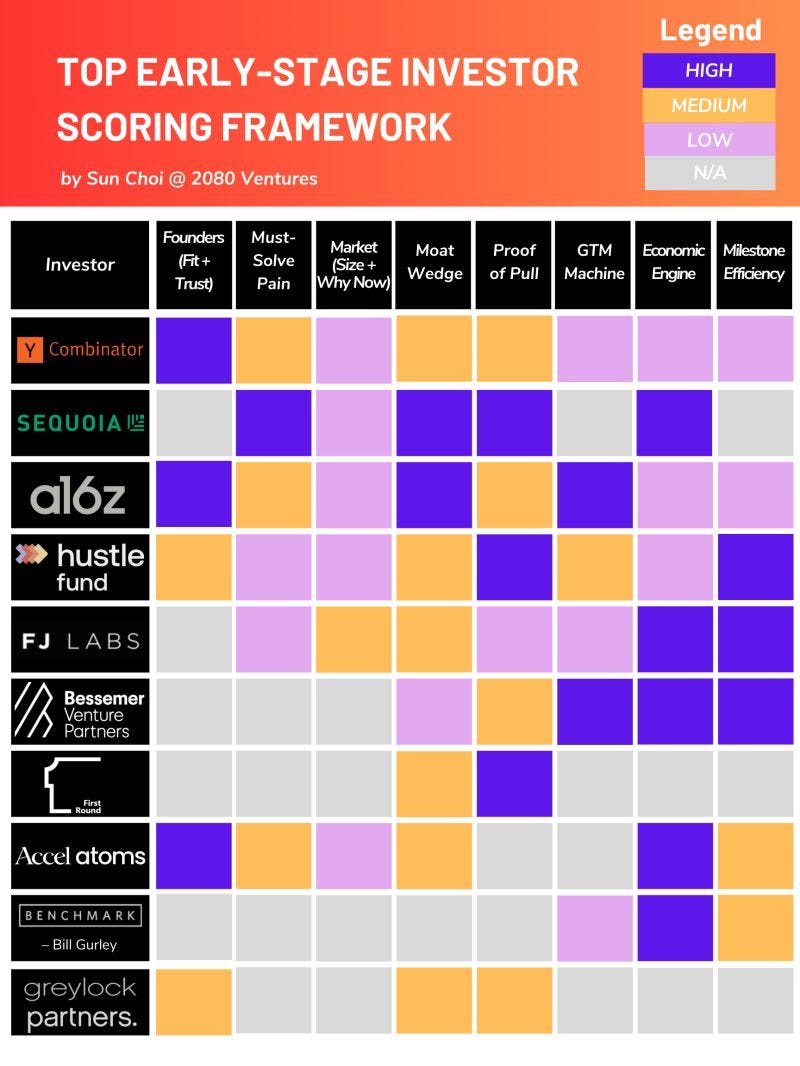
Across Sequoia, a16z, Benchmark, YC partners, and sovereign fund committees, the components rhyme.
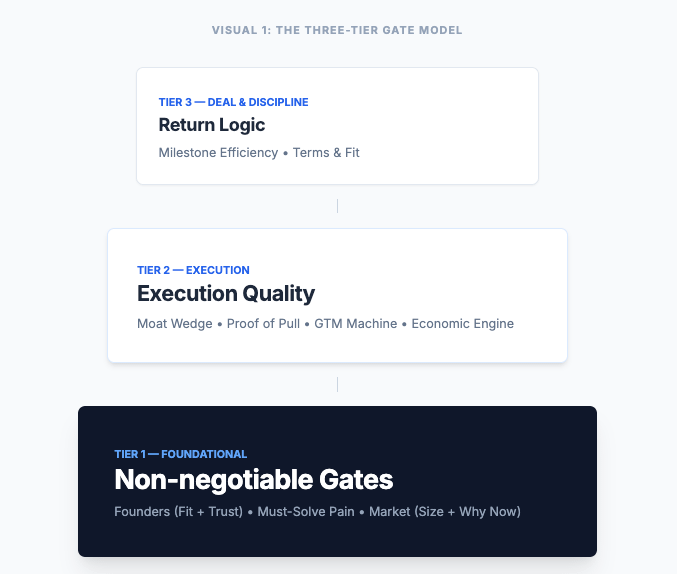
When you strip jargon away, the scorecard collapses into three tiers:
Tier 1 — Foundational
“Should this exist, and is this the team?”
Founders (Fit + Trust)
Must-Solve Pain
Market (Size + Why Now)
If Tier 1 breaks, nothing else matters.
This is the kill zone.
Tier 2 — Execution
“Can this actually compound?”
Moat Wedge
Proof of Pull
GTM Machine
Economic Engine
This is Series A territory.
This is where real valuation happens.
Tier 3 — Deal & Discipline
“Will this produce venture-scale returns?”
Milestone Efficiency
Terms & Fit
This is where many good companies die — not because they can’t build, but because the cap table is broken or capital discipline is nonexistent.
This does two things psychologically:
Founders see where they actually are
Investors recognize the language instantly
The weighted score VCs never show you
Behind closed doors, investors don’t think in bullet points.
They think in weights.
Seed — the bet is on founders + pain
Execution is optional, learning speed is not.
Series A — repeatability or no deal
Revenue without repeatable pull is noise.
Growth — efficiency or goodbye
Capital efficiency becomes the religion.
When you express this as weights, the game gets very clear.
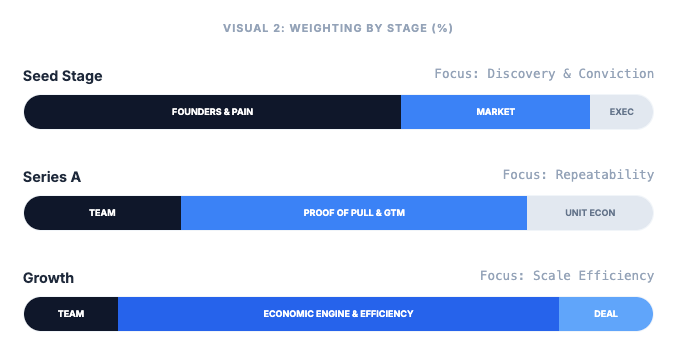
The reaction pattern I see:
founders: “Ah… that’s why they said no”
investors: silent nodding
This chart changes how people think in 3 seconds.
So what are investors actually scoring?
They’re not scoring your deck.
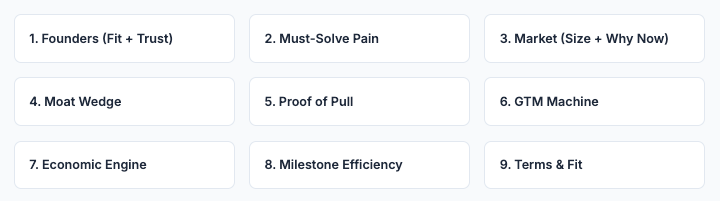
They’re scoring these nine things:
Founders (Fit + Trust)
Must-Solve Pain
Market (Size + Why Now)
Moat Wedge
Proof of Pull
GTM Machine
Economic Engine
Milestone Efficiency
Terms & Fit
Here is the hard truth:
You don’t need a better pitch.
You need a company that scores higher across the right dimensions.
Founders vs Founders: same revenue, different outcome
Two startups both doing $1M ARR.
Startup A:
hero founder story
momentum on Twitter
churn hidden in footnotes
“partnership pipeline” that doesn’t convert
Startup B:
quiet team
boring market
boring deck
repeatable GTM + strong NRR + real wedge
Guess who gets funded?
The one with better score shape, not better branding.
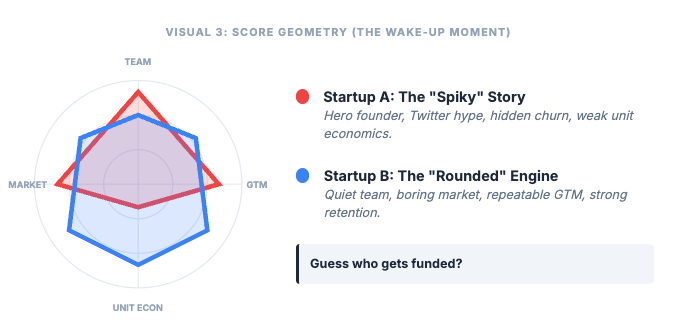
Every founder I’ve shown this to has the same reaction:
“…I get it now.”
Reverse-engineer yourself
If you take one thing from this newsletter, let it be this:
Stop trying to convince investors.
Start becoming the investor of your own company.
Ask yourself:
Would I invest in myself at this price?
How does my radar chart actually look?
Which tier am I really stuck in?
What specific score has to move from 2 → 4?
Fundraising then becomes simple:
Fix the score, not the story.
What I’m building next (for you)
I’m turning this into:
a downloadable investor scorecard
self-scoring tool for founders
anonymized benchmark dataset
workshop version for accelerators & governments
Because founders shouldn’t have to guess the rules of the game.
Close
VC is not magic.
It is structured judgment under uncertainty.
If you learn the structure, you stop guessing.
And when founders stop guessing, ecosystems level up.
— Sun Choi
Sources & Methodology
This framework is a reverse-engineered synthesis, not an official IC scorecard from any single firm.
It is derived from public partner writings, talks, and observable investment behavior across top early-stage investors, combined with repeated startup evaluation work.
Investor reference points (one-line):
Sequoia Capital — Emphasis on enduring customer pain, pull, and long-term economic engines (Sequoia Pitch Deck; partner essays and talks).
Andreessen Horowitz (a16z) — Strong focus on founder quality, market size, differentiation, and GTM as strategic advantage (Marc Andreessen on PMF; a16z blog and podcasts).
Benchmark — Consistent prioritization of market structure, pricing power, and unit economics over early hype (Bill Gurley’s writing and public interviews).
Y Combinator — Founder-first at Seed with heavy weight on early user pull and speed of learning, less on polished metrics (Paul Graham essays; YC Startup Library).
Bessemer Venture Partners — Clear, explicit focus on scalable business models, unit economics, and milestone discipline (Bessemer investment memos; Anti-Portfolio).
Hustle Fund — Early signal–driven approach emphasizing speed, execution, and initial pull over perfection (Elizabeth Yin’s public writing).
FJ Labs — Marketplace-driven framework centered on unit economics, liquidity, and milestone efficiency (Fabrice Grinda’s blog and talks).
“H / M / L” reflects relative early-stage emphasis, not permanent importance across all stages.
The intent is not to claim insider access, but to make consistent investor decision patterns explicit, so founders and investors can reason about fit instead of guessing.
SCORING TEMPLATE
It’s FREE to download. Feel free to leave any comments if you have any other ideas to improve the template for others!