I do not write about books often.
Most business books are just LinkedIn posts stretched into 200 pages. Good packaging. Weak operating value.
Yaron Flint’s new book, Beyond Networking, is not that.
I read an advance copy recently, and it gave me cleaner language for something I keep seeing across cross-border deals.
Most cross-border rounds do not fail because of the deck.
They fail because the network was built wrong from the start.
Founders usually blame the obvious thing.
The pitch was weak.
The valuation was too high.
The traction was not strong enough.
The market timing was off.
Sometimes that is true.
But a lot of the time, the real problem is simpler and harder to admit: the founder is trying to unlock trust, access, and collaboration in a market where none of those foundations exist yet.
That is not a deck problem.
That is a network architecture problem.
This is why I liked Yaron’s framing.
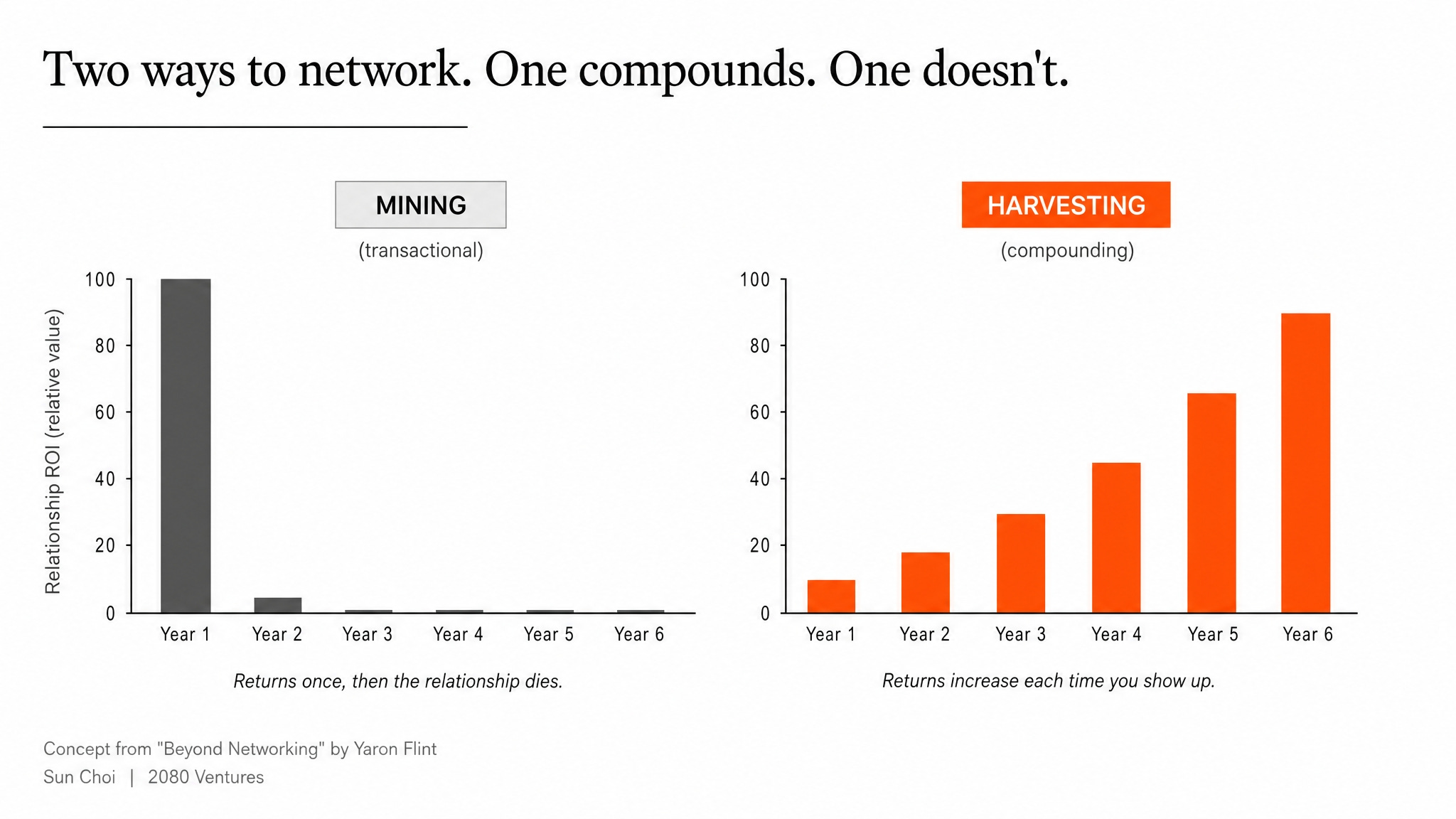
He separates networking into two modes: mining and harvesting.
Mining is what most people do.
They look for value.
Extract what they need.
Move on.
It works once. Maybe twice.
But it does not compound.
Harvesting is different.
You return.
You nurture.
You make the relationship stronger each time, instead of thinner.
That distinction sounds simple, but it explains a lot of broken cross-border fundraising behavior.
I see founders enter a new market and immediately ask for investor meetings, pilot customers, partner intros, or strategic support. In their head, this is efficient. In practice, it reads as extraction.
The other side may still be polite.
They may even take the meeting.
But the relationship is already weak because the founder showed up in mining mode.
That is why some founders collect many meetings and still build no momentum.
The meetings were real.
The trust was not.
Another line from the book stayed with me even more.
Win-win is an outcome, not a starting point.
That is one of the cleanest sentences I have seen on partnership.
A lot of founders walk into the first conversation already trying to engineer mutual benefit. They want to show value immediately. They want to prove the deal makes sense for both sides.
Sounds smart.
Usually it is too early.
At that stage, you do not have partnership yet. You have contact.
And when you force win-win before trust exists, what you call collaboration often feels like negotiation.
That is where many cross-border relationships go wrong.
The founder thinks, “I am being strategic.”
The other side thinks, “This person is asking too fast.”
Then the founder gets a soft no and assumes the market is cold.
Sometimes the market is not cold.
The sequence was wrong.
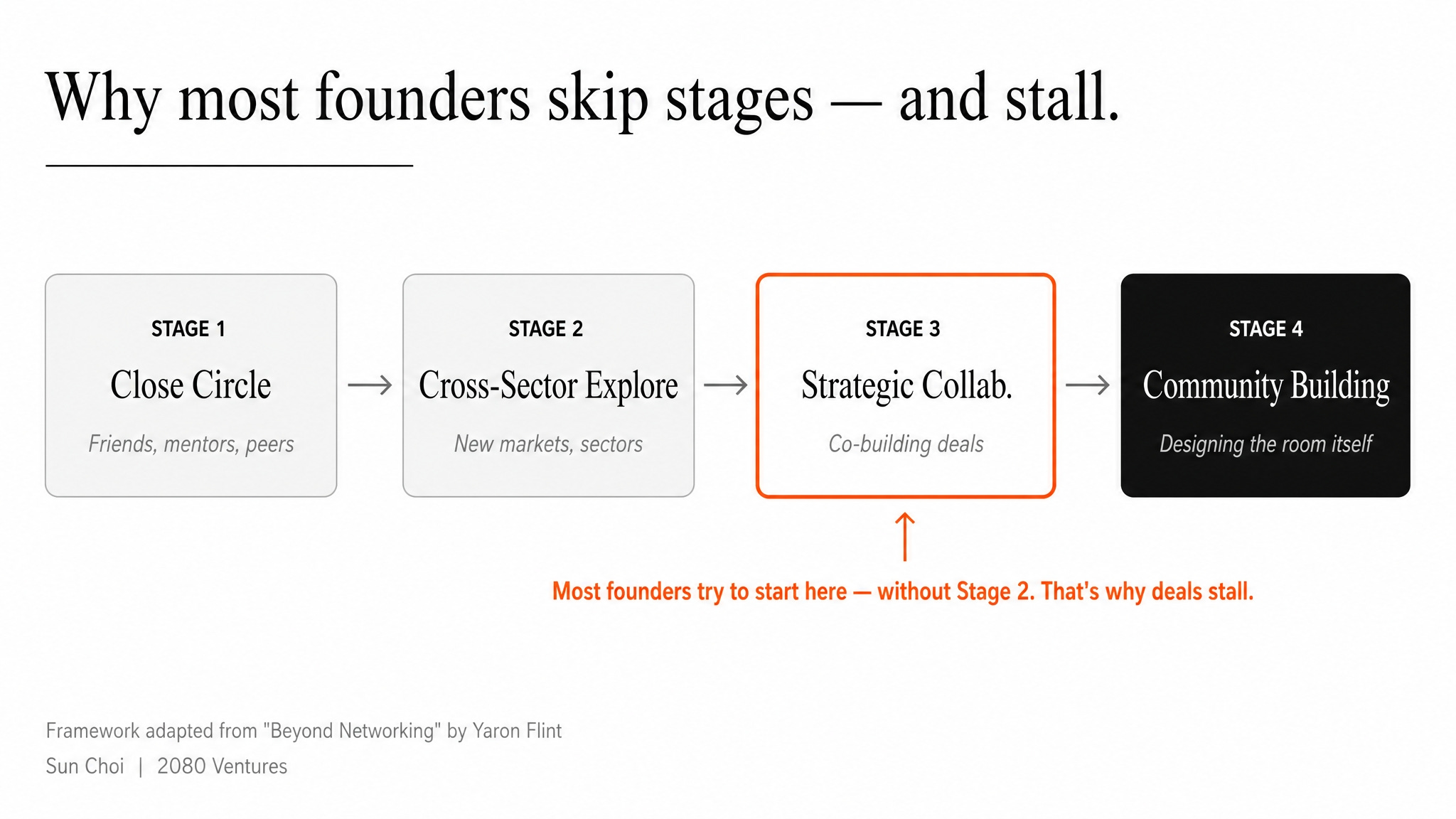
This is where the book’s four stages become useful.
Close Circle.
Cross-Sector Exploration.
Strategic Collaborations.
Community Building.
Most founders want Stage 3 outcomes in a market where they have not even completed Stage 2 work.
They want strategic collaboration before real exploration.
They want high-trust outcomes before low-pressure repetition.
They want the room to open before anyone knows why they belong in it.
That is why deals stall.
Not because the founder is bad.
Not because the opportunity is fake.
Because they skipped stages.
I have seen this in Korea to US rounds, Japan partnerships, MENA market entry, and corporate innovation programs.
The pattern repeats.
People overestimate what one good intro can do.
They underestimate how much repetition builds permission.
A founder gets one intro to a strong investor and thinks access problem solved.
It is not.
One intro does not replace network depth.
One meeting does not create market credibility.
One warm contact does not mean the ecosystem now carries you.
This is also why I think the book matters beyond “networking.”
It is really a book about how meaningful access is built.
And in cross-border work, access is not a side issue. It is often the whole game.
If you are raising abroad, entering a new market, building a corporate partnership, or trying to create multi-country ecosystem trust, this matters more than your networking style, your personal brand, or your event count.
It comes down to one uncomfortable question:
Are you building relationships that compound, or are you just collecting interactions that decay?
That is the real filter.
Not “How many people did I meet?”
Not “How many VCs replied?”
Not “How many cards did I collect?”
A better question is this:
Did this relationship get stronger after the interaction?
If the answer keeps being no, the problem is not activity.
The problem is design.
That is why I think Yaron got this one right.
Beyond Networking is not useful because it tells people to be warmer or more human. Plenty of books already do that.
It is useful because it gives structure to something many people feel but cannot name:
why some relationships open markets, and others only create motion.
And in cross-border work, confusing motion with traction is one of the most expensive mistakes you can make.
If you work on cross-border fundraising, corporate innovation, or ecosystem building, this book is worth your time.
Not because it teaches you how to “network.”
Because it explains why so many supposedly strategic relationships never become useful when it actually matters.