
Every fund application has a box marked track record, and the box has a shape.
I have run accelerator programmes under contract for a Gulf sovereign foundation, a Jordanian ministry financed by the World Bank, a Cambodian government agency, and Korean and Japanese public bodies. Multi-year mandates, renewed. Several hundred companies through them. On the other side of the table I have picked companies myself as general partner of small Korean funds, with my own investors' money in them.
The box does not have a shape for any of that. It wants prior fund returns in a format the industry agreed on some time ago and has not revisited.
Most people in that position reach for the same sentence, and I have heard it from enough of them to know it word for word.
"I'm not a top-tier VC. That's why the money isn't coming."
It sounds like humility. It is a bad diagnosis. Accept it and there is nothing left to do, because you cannot decide to have spent fifteen years at Sequoia.
So instead of accepting it I went to look at what the box actually measures. Declare my interest as you read: I run a fund, the shape of that box affects me, and you should weigh what follows accordingly. I have put the findings that cut against me in here too.
What is in the research is stranger than either the humble version or the defensive one.
The ranking barely knows who is good
Forbes has published a list of the hundred best venture investors since 2001, every year but one. It is the closest thing the industry has to a public scoreboard.
Two Stanford researchers built their own ranking from the ground up.
They used 230,000 investments by more than 13,000 US investors, adjusting for valuations, dilution and how an investor's edge fades over time.
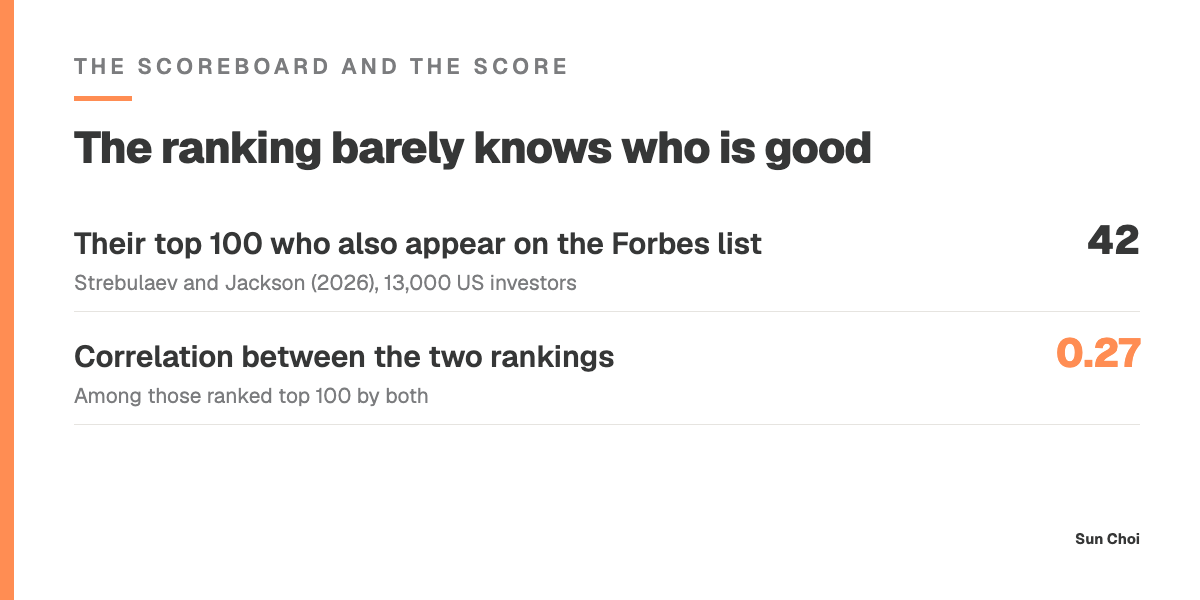
Then they compared their ranking to the Forbes list. Writing up their own results, the authors say the Forbes list misses 58 of their top hundred outright. One of those is in their top ten.
Among the investors who appear on both lists, the correlation between the two rankings is about 0.27. I am quoting their summary of the paper rather than a table inside it.
0.27 is a weak positive relationship. Not nothing. Nowhere near enough to sort people by.
Both papers I lean on here are 2026 working papers. No peer review, no replication yet. If they do not hold, most of this goes with them. I use them because they are the best evidence that exists on the question, not because the question is settled.
And yet the ranking changes what happens next
Here is where it stops being a story about a magazine.
The same researchers went back with a larger dataset, covering more than 100,000 people who have worked at US venture firms.
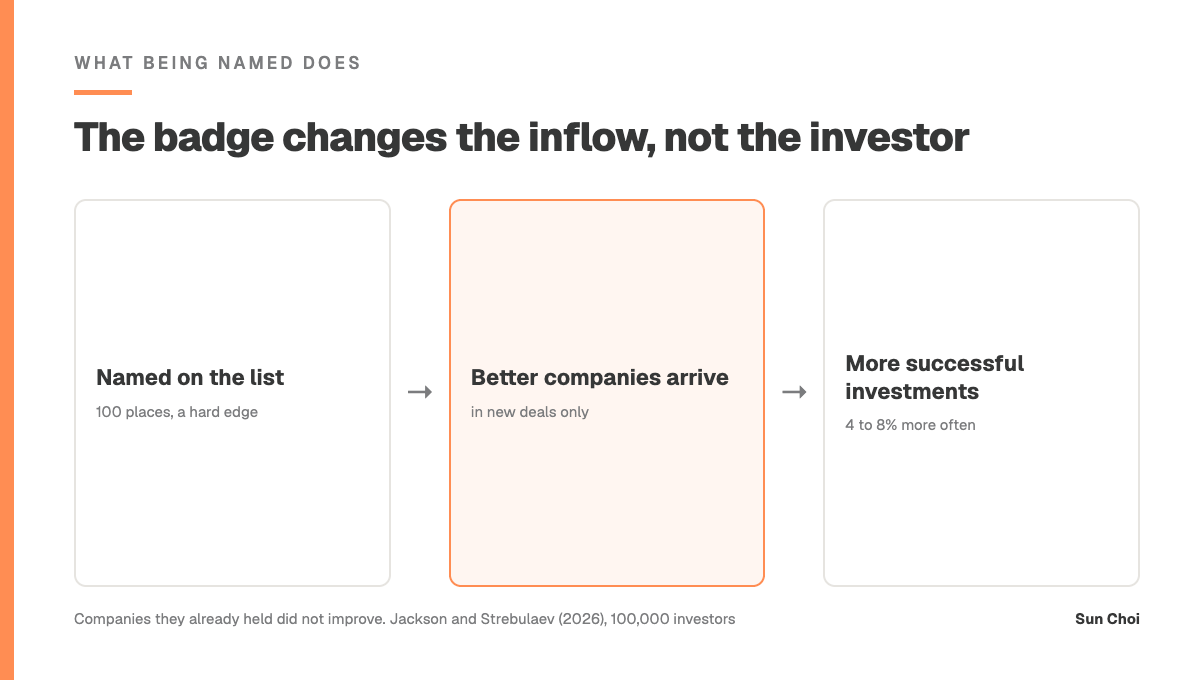
They wanted to know what the list does to the people on it. The list has exactly one hundred places, which gives you a hard edge. Some investors barely make it. Others barely miss. Those two groups look almost identical the year before.
In the years after, by the authors' estimate, the ones who made it invested in successful companies 4 to 8% more often than the ones who missed. The increase shows up only in new investments. The companies they already held did not improve.
The authors read this as access rather than skill, and I think they are right, though access is not the only story that fits. A well-known name may also make founders choose that investor when they have options. Either way the change is in what reaches the investor, not in the investor.
So read the persistence number again
The most-used screen in institutional allocation is a manager's last fund. If it was top quartile, you look. If it was not, you often do not.
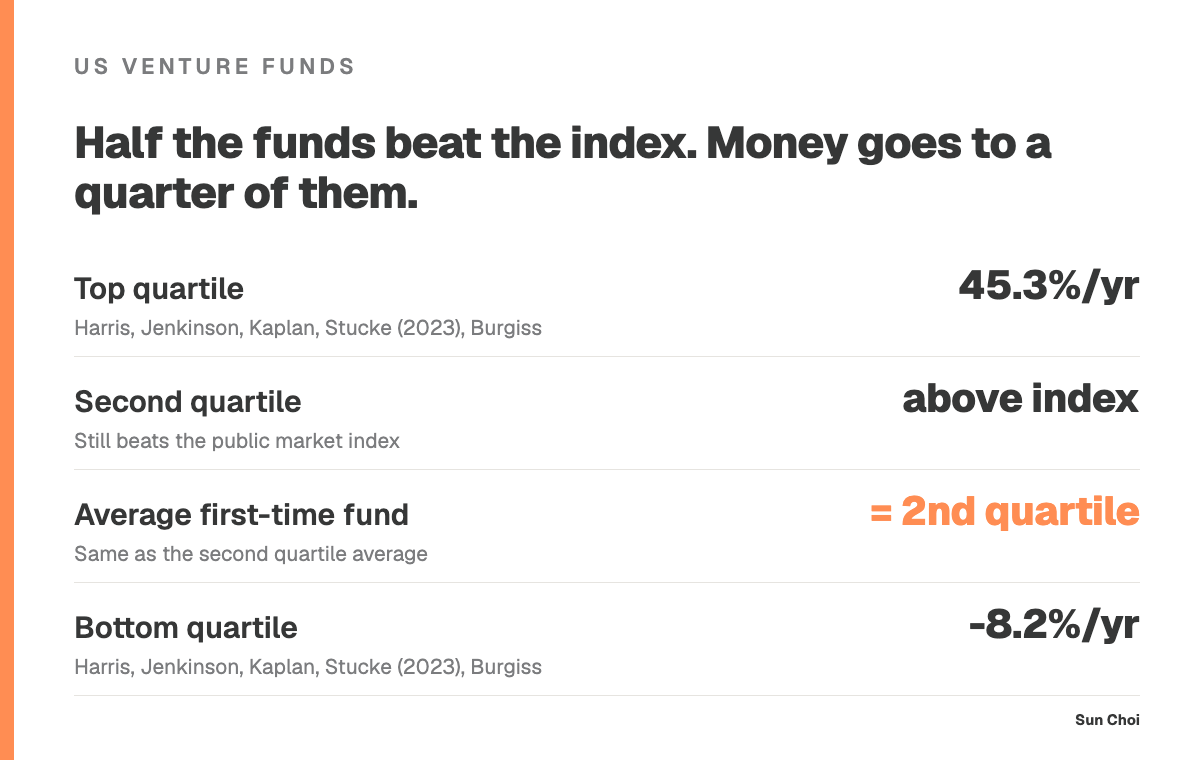
Measured against outcomes, the screen works. A manager whose last fund was top quartile lands there again 45% of the time.
With four quartiles, chance alone would give you 25. That is close to twice the base rate. Anyone who tells you past performance means nothing is arguing with the data.
Two things about that number before it gets used as a fact.
The paper is called "Has Persistence Persisted". The answer it gives is a qualified yes for venture and close to a no for buyouts. Even for venture, persistence weakens in funds raised after 2000.
It is a live number, not a constant, and it has been moving in one direction.
So the screen carries signal. Keep that. What the two findings above establish, separately and on their own terms, is narrower and harder to dismiss.
One. The public ranking does not track measured skill. That is a straight comparison of two rankings over the same people.
Two. Being on it changes which companies reach you. That is a causal estimate inside its own study, on individual investors and their deal flow.
Visibility and merit are separable. Visibility moves outcomes on its own.
Nobody has shown that the second explains the first, and I am not going to pretend otherwise. The two studies look at different objects.
A manager with no visibility is not producing a weaker signal than a manager with it. They are producing a signal through a narrower pipe.
And this is not a case for ignoring reputation. If a well-known investor genuinely sees better companies, their next fund genuinely is more likely to work. Backing them is a reasonable thing to do.
Reputation is doing real work here. Just not the work it gets credited with. It buys access. It does not certify judgement.
The question is what that leaves out.
Then pick good people instead
This is where I expected the research to rescue everyone. It does not.
The same study of 100,000 investors looked at who actually performs. The answers are specific and, at first, satisfying.
Investors who were the founder or CEO of a successful startup make about 35% more successful investments over a career than average. Founders of unsuccessful startups make about 24% fewer.
People who worked at a startup without running one show no effect at all. It is the seat that matters, not the exposure.
Having an MBA is associated with fewer successful deals. Having a top-ten MBA is associated with more. The school matters; the degree does not.
Then the last section of the paper takes it all back.
In this dataset, none of those characteristics show up in fund returns. Not in net IRR, not in TVPI.
They predict how many successful companies a fund invests in, and that is where the trail goes cold. The authors checked small teams, where one person's contribution should be easiest to see. Still nothing.
They predict who picks well. They do not predict what an investor gets back.
One dataset, one period, and absence of a signal is not proof there is none. But it is the largest anyone has assembled on the question, and it did not find what almost everyone assumes is there.
Picking good companies and returning money to investors are two different machines. A résumé tells you about the first one.
Where the return is actually decided
Duller explanations go first. Fund size, fee load, luck, and the fact that a good part of what gets called a fund return is still an estimate on companies nobody has sold.
Whatever survives those happens after the pick. How much went in. When more went in. What it was bought at. What came out and when.
There is one more finding that runs against the price of experience. Funds that let someone in their first five years lead a deal invest in more successful companies than funds that do not. And the ranking model that fits the data best assumes an investor's edge fades by half every three years.
Whatever is being paid for when an allocator pays for twenty years of experience, the data does not say it is that.
The half that cuts against me
I should put my own bad number on the table, with the caveat that applies to every private index. Managers value their own unsold companies, and funds that die quietly stop reporting. Both push the number up. Read what follows as the flattering version.
Cambridge Associates publishes an index of emerging markets private equity and venture funds, net of fees.
Measured against global developed equities it lost over one year, three, five, ten and fifteen. It edges ahead only at twenty, and barely.
I invest in emerging markets. That is my index, and it has not beaten the world's stock market over any horizon a person actually plans around. I spent a long time explaining that away before I stopped.
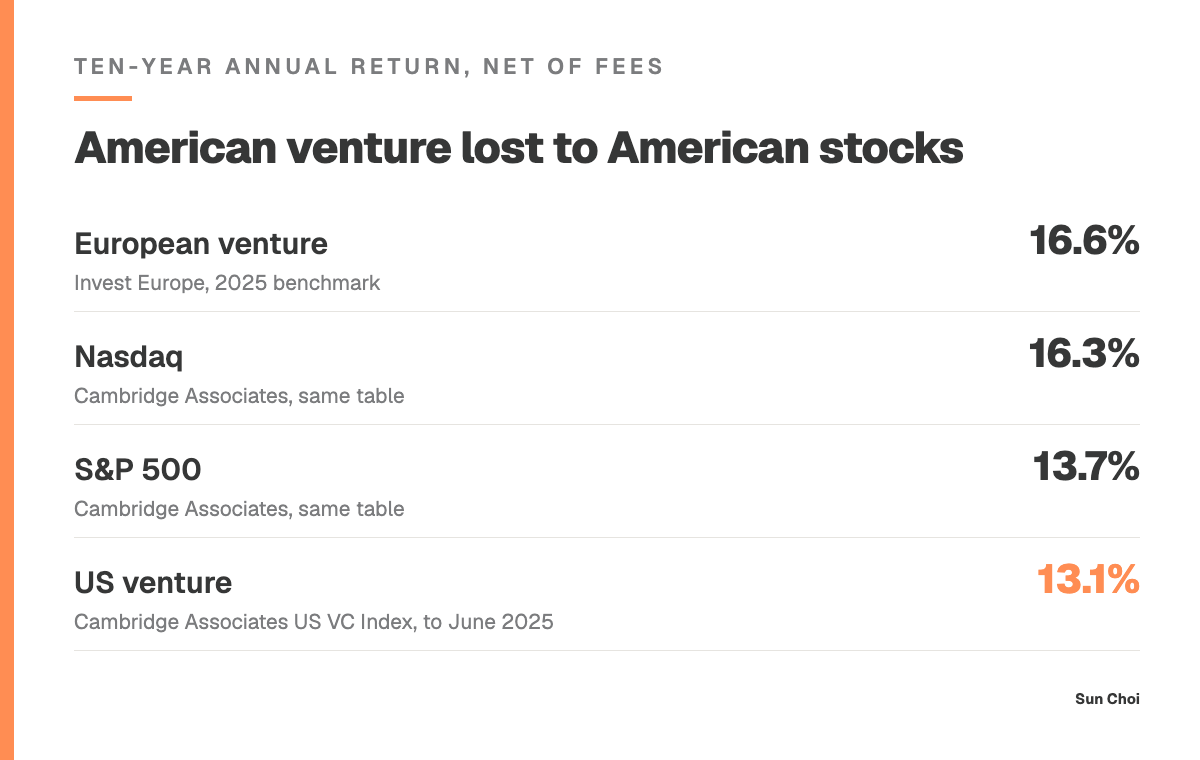
Measured against emerging markets public equities, the market these funds actually operate in, the same index wins from ten years out and by about four points a year at fifteen.
Both are true. And notice what I just did. I picked the comparison that flatters my own asset class.
There is an argument for it. Those funds buy companies in those economies. But an investor deciding where to put money is choosing against everything, and for most of them the honest default is global equities, which is the line my index loses to.
Which line you compare to decides the answer. Almost nobody chooses it deliberately. They inherit it, and the inherited one usually flatters somebody.
The ruler was made somewhere else
The same thing happens between countries. You will see country averages quoted side by side. One number for American funds, a lower one for Japan, a lower one again for Korea, each from a different source with different vintages, different currencies and different rules about which funds count.
I am not going to reprint them, because printing them is the whole problem. Set next to each other they read as a ranking, and they are not one. Anyone who quotes that sequence at you, including me, is doing arithmetic on numbers that were never built to be compared.
The useful fact is the absence. Nobody can tell you what the return distribution of Korean venture actually looks like next to the American one, because that comparison has not been built.
Meanwhile Korean institutions select managers in vocabulary that assumes the American one. Top quartile. Power law. One deal returns the fund.
Borrowing the words is free. Borrowing the distribution behind them is not, and nobody has checked whether it came along.
What to ask instead
If the ranking partly causes what it measures, and a résumé stops explaining things at the fund line, then scoring managers on record is doing less work than it appears to.
What is left is a set of questions. Not mine. Each is the practical form of a finding above, and each can be answered by someone with no record at all.
Where do the good companies come from? A survey of 885 investors found only one deal in ten arrives inbound from founders. The rest come from networks and from going out and finding them.
So "we have a great network" is not an answer. The answer is what happens because of you that would not otherwise happen.
Will this person still be here? Who sits on a board explains more about whether the company eventually goes public than which firm that person works for. Skill travels with the person.
Your risk is not the brand. It is the departure.
Is the portfolio built for this market's distribution? Not the one in the textbook. The one where the money actually is.
How does anyone get out? In Southeast Asia the very largest exits stopped clearing while the small end kept moving. Top-decile exit values in 2024 came in well below 2022, and median and upper-quartile values rose over the same stretch.
Where the window is that narrow, "and then they go public" is not a plan.
When does the follow-on money move? Investments made at a distance perform better at exit when the money goes in over several rounds rather than all at once.
If the reserve is money left over rather than money attached to a gate, it is not doing the work it could.
Two of those are about picking. Three are about what happens after the pick, which is where the return is actually decided.
And nobody has shown that asking them improves selection. There is no study where investors who asked did better. I am turning findings into questions, which is a weaker thing than evidence. What I will claim is only this: each points at something a study found, and none of them need a record to answer.
They do not produce a number you can rank. They produce a conversation in which a manager either explains their own machine or cannot.
None of this makes a first fund a good bet. It makes the record a weaker instrument than it is treated as.
So here is what I would like to know. What is the last thing you learned about a manager that their record could not have told you?
Sources: Strebulaev and Jackson (2026), "Ranking Venture Investors," SSRN 6833760. Jackson and Strebulaev (2026), "Human Capital in Venture Capital: Evidence From 100,000 Venture Capitalists," NBER 35501. Harris, Jenkinson, Kaplan and Stucke (2023), "Has Persistence Persisted in Private Equity?", using Burgiss data. Gompers, Gornall, Kaplan and Strebulaev (2020), "How do venture capitalists make decisions?" Ewens and Rhodes-Kropf (2015) on board members versus firms. Tian (2011) on staging and distance. Cambridge Associates Emerging Markets PE and VC Index, September 2025. Korea Ministry of SMEs and Startups, liquidated venture fund briefing, April 2021. Cento Ventures, Southeast Asia Tech Investment 2023 to 2024. Japan Venture Capital Association with Preqin, domestic VC performance benchmark, sixth survey.
If this was useful, subscribe. Every other week, one piece on how capital actually moves in the markets I work in, written from inside the deals rather than above them.