Your “pilot” doesn’t fail in the lab.
It dies in procurement—because you show up with a product, not proof
REALITY (What changed in the last week)
Security requirements are becoming mandatory gate checks, not “nice-to-have.” Even platform ecosystems are tightening baseline requirements and validation cycles that ripple into enterprise buying behavior. Microsoft Learn
Sanctions lists keep expanding and enforcement keeps getting more operational, especially around shipping, services, and “shadow networks.” If you can’t screen counterparties and explain your exposure, procurement won’t carry your risk. Regeringskansliet+1
National security language is bleeding into commercial contracts. Not just defense. Not just “regulated industries.” It shows up as: representations, audit rights, termination triggers, data location requirements, and “who owns what” in the event of an incident.
THE COLD TRUTH (Brutal but useful)
Procurement doesn’t buy innovation. Procurement buys risk transfer.
Your PoC is a risk discovery exercise for the buyer. If you can’t pre-answer the risk questions, you extend the sales cycle by 60–180 days.
“We’ll handle compliance later” is the fastest way to never get paid.
In cross-border deals, “payment terms” are a compliance problem. Withholding tax, VAT, FX controls, sanctions screening, and invoice rules can block cash even after “yes.”
Data residency is not a feature request. It’s a deal constraint. If you can’t map data flows in plain English, you don’t have a deal.
Geopolitics isn’t a headline. It’s a clause. “Change in law,” “sanctions,” “export controls,” “force majeure,” “termination for convenience,” “government access,” “subprocessor restrictions.”
FRICTION (Why pilots stall)
Here’s the actual bottleneck pattern I keep seeing:
Week 0–4: Business team loves the PoC idea.
Week 4–8: Procurement asks for vendor package + security artifacts.
Week 8–16: Legal + security review starts. Founder answers ad-hoc.
Week 16–24: Internal stakeholders rotate. Deal owner changes. Risk appetite changes.
Week 24+: “Let’s revisit next quarter.”
The PoC didn’t fail.
You failed to operationalize the buyer’s risk process.
TRANSLATION (What buyers are really asking)
When procurement/security/legal asks you for “documents,” they’re asking:
Can we survive an audit if we use you?
Can we survive a breach if we use you?
Can we exit you cleanly if things go wrong?
Can we pay you without creating tax/sanctions problems?
Can we prove we did due diligence if regulators ask later?
If your answers live in your head—or scattered Slack messages—you are not enterprise-ready.
THE STRUCTURE (Artifact): The “Procurement Close Pack” (PCP) — 12 items that move deals
This is the simplest high-leverage system I’ve found for cross-border pilot→contract conversion.
A) One-page “Risk Translation Sheet” (1 page, non-lawyer English)
What you do (one sentence)
Where data flows (1 diagram)
Where data is stored (regions)
Your subprocessors (link or table)
Your breach response window (SLA)
Your “we do / we don’t” list (boundaries)

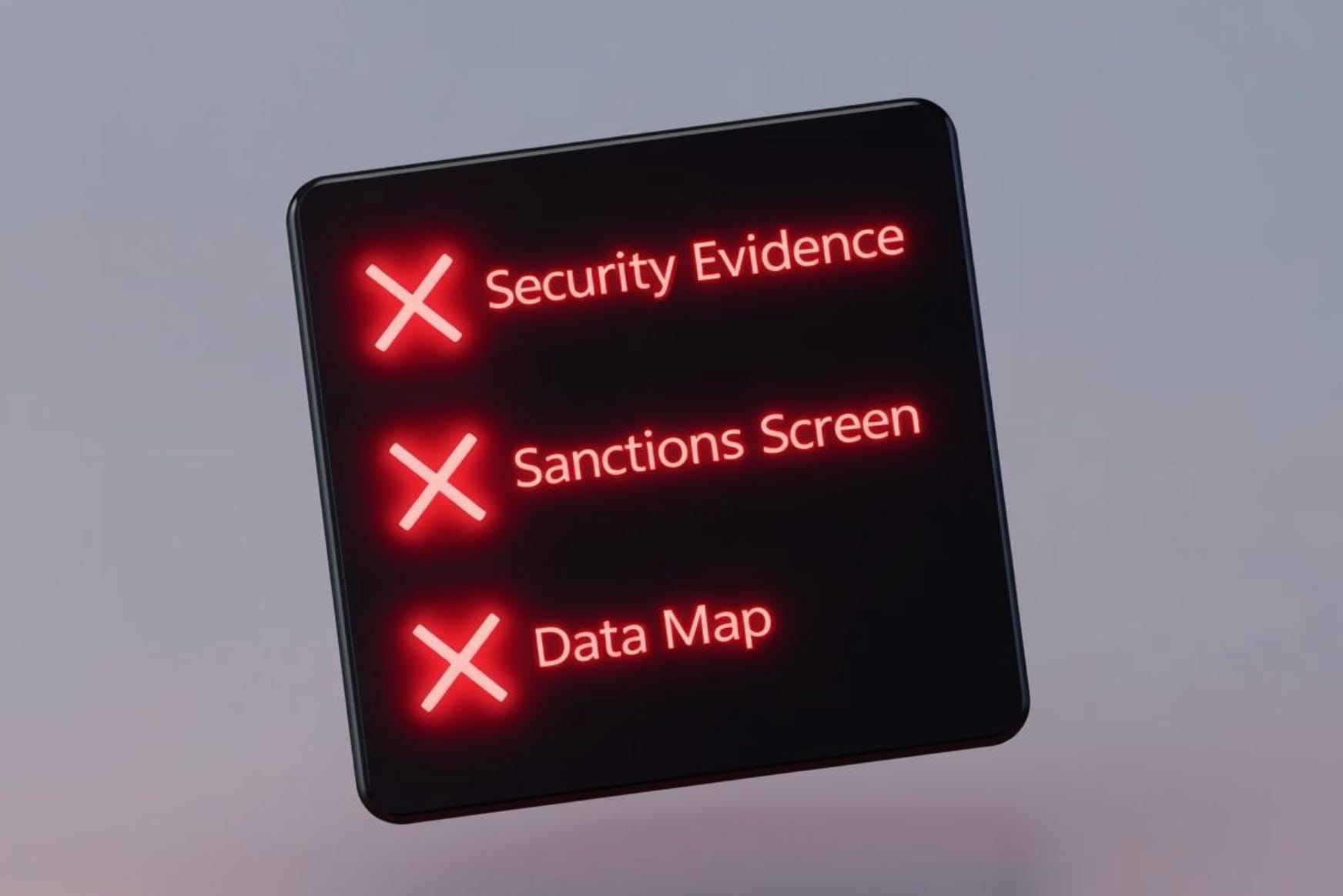
B) Security Evidence Bundle (attach once, reuse forever)
SOC 2 / ISO 27001 (or a realistic timeline + interim controls)
Latest pen test summary (executive summary + remediation status)
Vulnerability management policy (how fast you patch what)
Access control model (SSO, MFA, RBAC)
Incident response plan + last tabletop date
Business continuity / backups (RPO/RTO)
If you don’t have SOC2 yet, fine—but you need a credible “control narrative.” Procurement will accept maturity. They won’t accept vagueness.
C) Data & Privacy Pack (cross-border specific)
Data Processing Addendum (DPA) baseline
Data residency options (what can be pinned where)
Cross-border transfer mechanism (what you rely on; who signs)
Subprocessor list + change notification policy
Data retention/deletion policy
D) IP & Ownership “No-Surprises” Page
Who owns pre-existing IP
What the customer owns (deliverables? outputs? data?)
What happens to models/configs after termination
Any open-source exposure (SBOM if relevant)
E) Sanctions / Export Controls Statement (simple, serious)
Screening process (tools + cadence)
Restricted jurisdictions policy
“We will not support sanctioned end users” clause
Triggers for immediate suspension/termination
This isn’t politics. This is operational survivability—especially for global enterprises. Regeringskansliet+1
F) Commercial Pack (the part founders under-build)
Pricing page (clean tiers, no surprises)
Payment terms (Net 30/60/90) + late fee policy
Invoicing fields required (PO, vendor ID, tax IDs)
Withholding tax handling (who bears it, what certificates you can provide)
FX clause (who eats volatility if currency swings)
G) Procurement-Friendly PoC KPI Sheet (the conversion bridge)
KPI definition (measurable, auditable)
Baseline → target
Data owner on customer side
Success = “contract trigger” definition
Failure = “exit cleanly” definition
Most PoCs die because success was never defined in a way procurement can approve.
DEAL OUTCOME (What this changes in the real world)
When you show up with the PCP on Day 1:
Security/legal doesn’t block the business team; they parallel-process.
You reduce “document ping-pong” and stop rewriting terms from scratch.
You turn “we liked the pilot” into a procurement-ready narrative.
You give the buyer a defensible file for internal audit.
This is how pilots become contracts.
ACTION (Exact next steps)
If you’re a startup founder (selling cross-border):
Build the Procurement Close Pack in a shared folder this week.
Create a 1-page Risk Translation Sheet and send it before the first PoC call.
Ask for a procurement/security intake call in Week 1, not Week 8.
Define PoC success as a contract trigger, not “learning.”
If you’re a corporate buyer (OI/BU/Procurement):
Require a Risk Translation Sheet before approving any PoC budget.
Standardize your “minimum vendor evidence” checklist so innovators don’t guess.
Make PoC success measurable and procurement-convertible (KPI → contract).
QUESTION
What kills more deals in your world right now—security evidence, data residency, or payment terms?
Comment with one word: SECURITY / DATA / PAYMENT.