
A fund I know sent out a founder update last month with a dilution table. $28M raised across three rounds, clean waterfall, clean math.
The math was wrong. Not the arithmetic. The assumption underneath it.
Every round in that table was treated as if it had already closed. No probability weighting on the rounds still in term sheet stage, no discount on the ones still in first conversations. A waterfall built that way isn't a forecast. It's a fiction with decimal points.
I keep running into this same failure, in different clothes, across every layer of cross-border work. Not bad judgment. Bad discipline about the one boring line that would have caught the error before it shipped.
The model that lies with a straight face
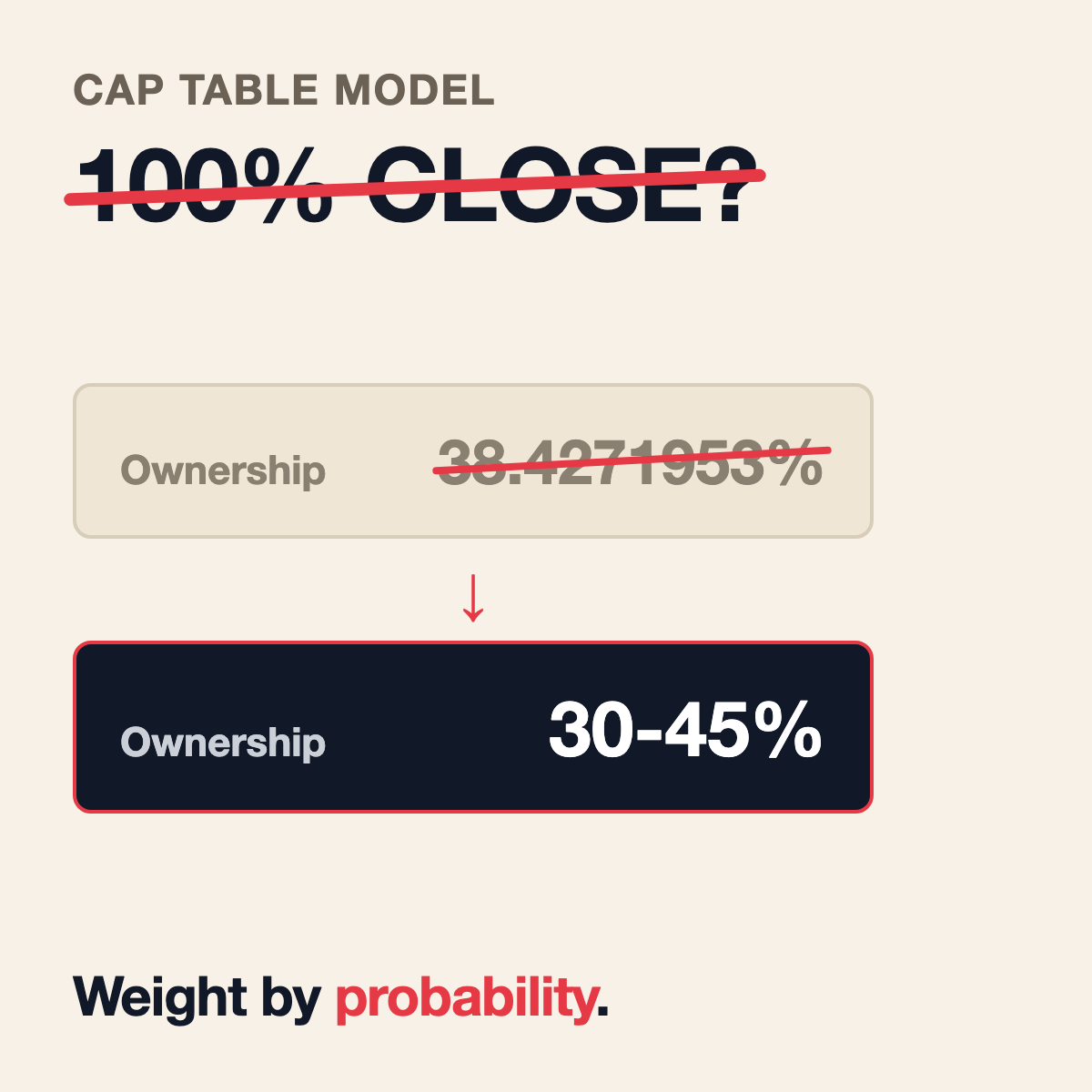
Dilution waterfalls get built by analysts who are good at spreadsheets and bad at admitting uncertainty. A term sheet is not a close. A close probability of 40% is not the same as 100%, and a model that doesn't weight for it isn't conservative or aggressive, it's just wrong.
This matters more in emerging markets than in Silicon Valley, because close rates on announced rounds are lower and take longer. A corridor deal that "closed" in a press release can still be six months from wire.
A dilution table with no probability weighting isn't a model. It's a press release with formulas.
If you're building cap table models for LPs or corporates, the fix costs you one column: probability of close, by stage, sourced from actual historical conversion in that market, not from Silicon Valley base rates. Skip it and you're not being efficient. You're publishing fabrication with better formatting.
The currency line nobody rereads
The second failure looks unrelated. It isn't.
Cross-border deal decks routinely say "$4.2M revenue" when the source document says 4.2M in local currency. Someone converted once, somewhere upstream, and the label never got fixed. By the time the number reaches an investment committee three hops later, it's been treated as USD the whole way.
A revenue line off by a currency label can be a 3-15x error depending on the corridor.
Nobody catches it because the number "looks reasonable" at either scale.
The fix isn't skepticism. It's going back to the source document, not the deck, and checking what currency the original figure was actually denominated in.
I have seen valuation conversations built entirely on a mistranslated decimal. Nobody lied. Everybody just trusted the second-hand summary instead of rereading the source.
The market that was underpriced because nobody designed for it
Here's where the pattern flips from risk to opportunity.
Cross-border founders build for their own passport. A Korean founder building for Korea, a Gulf founder building for the Gulf. Reasonable instinct. It also means an entire population gets systematically underserved: foreign residents trying to access local financial and administrative services in a country that wasn't designed with them in mind.
This isn't a vague pain point. It's a structural friction with a repeatable shape across corridors. Banking, tax filing, government registration, all built for citizens, all quietly broken for the resident foreigner navigating them in a second or third language.
Most founders don't see this as a market. They see it as a support ticket. That gap between "annoying edge case" and "validated problem space" is exactly where corridor capital should be looking, because it doesn't require betting on a new behavior. It requires noticing an old friction nobody priced.
Sequence before you spend the trip

The same discipline applies to how cross-border partnerships actually get built, and it's where I see the most wasted travel.
The instinct is to fly in, meet the ministry, meet the fund, meet the accelerator, and hope a roadmap falls out of the room. It rarely does. Relationships get formed at the summit. Roadmaps get confirmed on the site visit. Reverse that order and the site visit becomes a first date wearing a signing ceremony's clothes.
The same sequencing discipline shows up one level down, in the free-money conversation founders love most: government grants. Before anyone gets excited about a pre-seed or youth entrepreneurship program in a new market, the first filter isn't program quality. It's residency status. A program built for youth entrepreneurs in a given country doesn't care how strong your traction is if you don't clear the residency gate. That single check, done first, saves weeks of pitch prep for a program that was never eligible in the first place.
Same root behavior in both cases: check the gate before you spend the resource. Whether the resource is a flight or a grant application.
Give the number, not the interest
The last failure point sits closest to home, because it's the one that determines whether any of the above ever turns into capital.
A local partner trying to bring a deal to their leadership doesn't need your enthusiasm. They need a number. "We're interested" gets filed. "We can commit $250K to $500K at this stage" gets escalated.
The reason is organizational, not personal. That local partner has to walk into a room and defend a specific ask to people who weren't in your conversation. Vague interest gives them nothing to defend. A minimum commitment range gives them a line item.
This is the same discipline as the dilution table, just pointed inward. Don't let your own position sit unweighted and unspecified while you ask everyone downstream to move fast on it.
None of these five things are hard to fix. That's the point. Each one is a five-second check that got skipped because the bigger story, the raise, the market thesis, the partnership, felt more urgent than the boring line underneath it.
The corridor doesn't reward the better story. It rewards whoever actually reread the source document.
If this kind of cross-border field note is useful, more of these are coming. Subscribe and they'll land directly.