Originally published on LinkedIn (July 22, 2025). Archived here for long-term access.
If your end-of-year “impact” slide says:
15 events
300 startup applications
8 pitch days
500 attendees
…you didn’t do innovation.
You ran a checklist.
Open call ✅
Campaign ✅
Demo day ✅
Outcome ❌
And startups notice. Fast.
Table of Contents
The Checkbox Illusion
Why Startups Are Opting Out
The Metrics Misalignment Problem
What Real Impact Looks Like
Fixing the Incentives: A Way Forward
Final Thought: Be the Program Startups Recommend
FAQ
1) The Checkbox Illusion
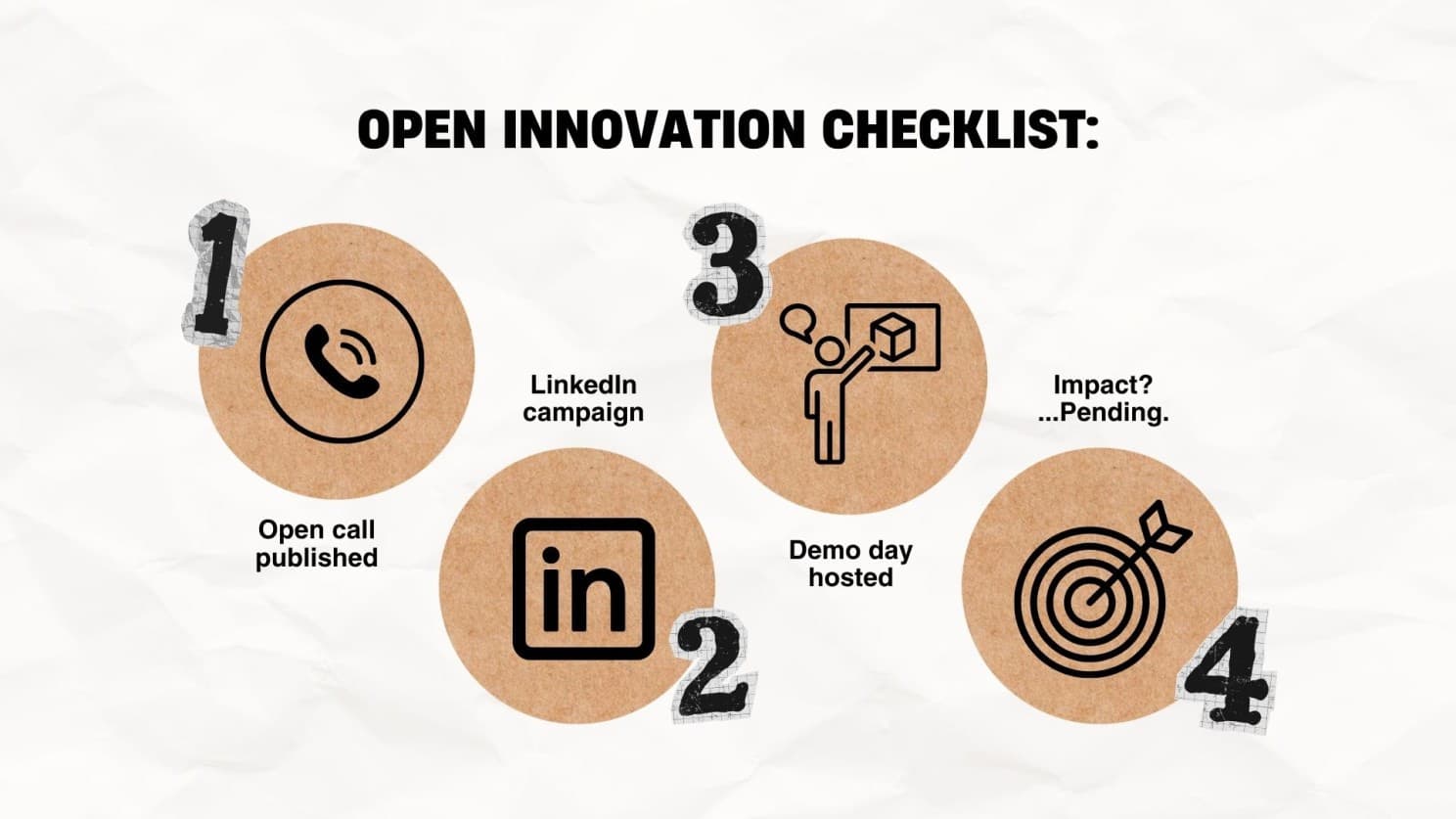
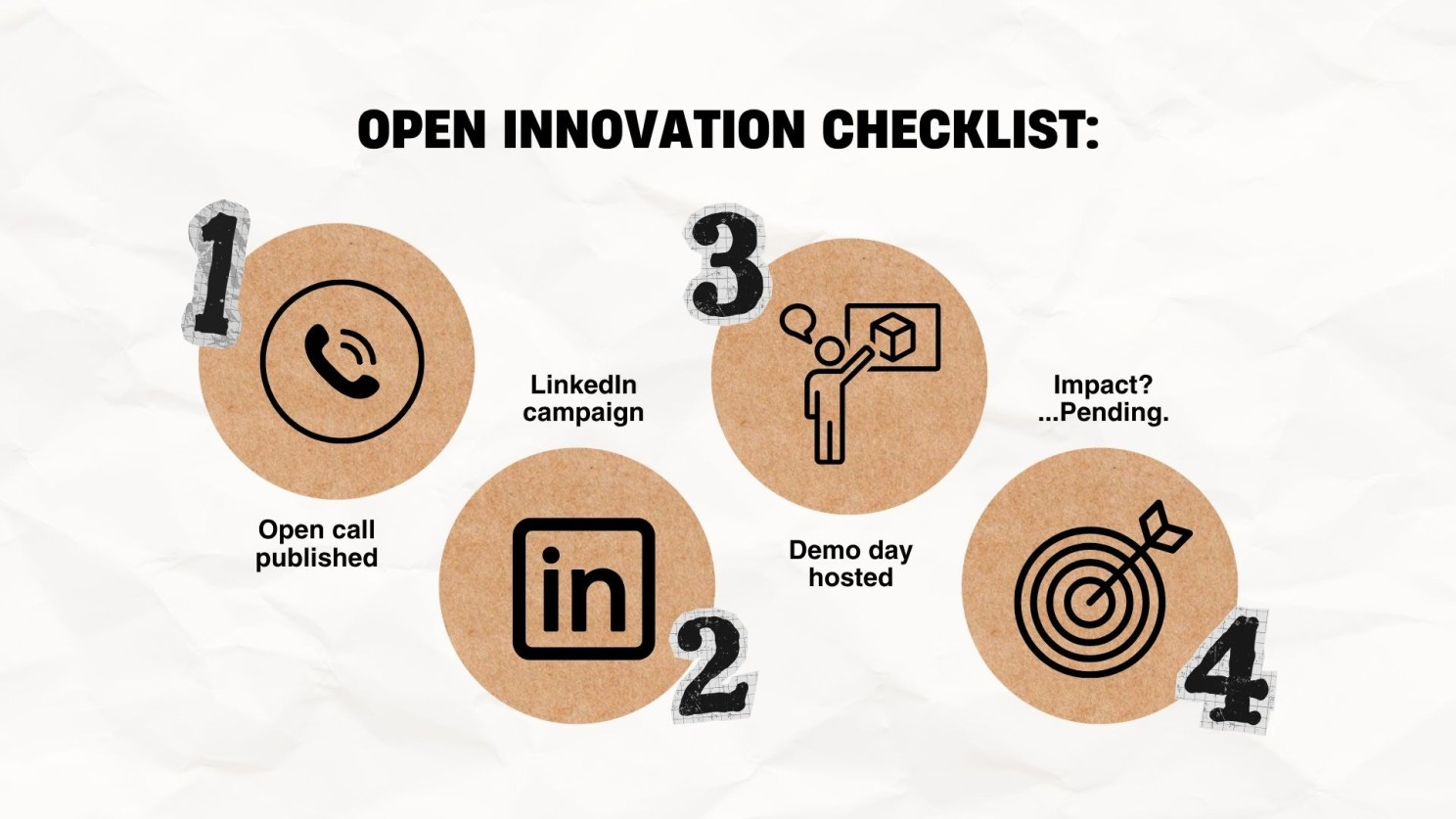
Too many innovation programs devolve into a slide-friendly ritual:
Open call published ✅
LinkedIn campaign ✅
Demo day hosted ✅
Impact? …Pending.
The damage is predictable:
Startups walk away frustrated
Internal champions can’t justify follow-up
Your brand becomes “the program founders warn each other about”
As Anders Graabæk (Lean Startup coach and accelerator designer) put it:
“If you’re funded by a third party, like the EU, the program becomes accountable to vanity metrics: bums in seats, number of workshops. Not actual startup success.”
Uncomfortable truth:
A lot of initiatives are designed to look good—not to solve something real.
2) Why Startups Are Opting Out
Founders are talking. And they’re voting with their calendars.
Isabelle Kent (CEO, Startup Leaders) said it clearly:
“Why go through middle men justifying their own jobs when you can go straight to decision-makers?”
That’s why more founders now refuse open calls unless they see:
budget
executive buy-in
a clear post-pilot path
Alexandra Botezatu (ex corporate innovation lead → startup founder) shared:
“I tried to launch a challenge from inside a corporate. It became a logistical nightmare before it even started—legal, compliance, marketing all pulling in different directions. We needed innovation. But the system made it impossible.”
This isn’t cynicism. It’s pattern recognition.
After enough rounds of ghosting and vague briefings, startups stop playing.
3) The Metrics Misalignment Problem
Here’s the root issue:
Innovation teams are evaluated by volume, not value.
So they track:
how many startups applied
how many workshops ran
how many internal teams “participated”
But they don’t track:
did we solve a business unit problem?
did we pilot → procure → scale?
did the startup grow, or did we just extract free labor?
Dr.-Ing. Joffrey Mabuma (startup COO & advisor) summarized it:
“Good intentions often get lost in process. Startups move fast while corporates need alignment. For real collaboration, follow-through matters more than open calls.”
If you don’t have:
executive sponsor
problem owner
budget
post-demo accountability
…even the best startup ends up in the innovation graveyard.
4) What Real Impact Looks Like
Real impact isn’t “we hosted a Demo Day.”
Real impact is:
a business pain point solved
a contract signed
a workflow adopted
a pilot that actually became something
Here’s what “success” should look like:
1) Business-Aligned Challenges
Don’t build a program and then go looking for problems.
Start with real BU pain points, then design startup engagement around solving them.
2) Commercial Outcomes You Can’t Fake
KPIs that matter:
signed pilot agreements
procurement deals
strategic investments
revenue-generating partnerships
3) Founder-Centric Design
As Emma McClenaghan (engineering founder) noted:
“If your challenge is 6 months and could be solved in 6 weeks, no good engineer wants to waste time.”
Speed is respect.
4) Post-Program Pathways
Demo Day isn’t the finish line. It’s the start.
Assign internal liaisons.
Share roadmaps and next steps.
Give feedback even when it’s a “no.”
As Jonas Wallengren (Virtuall.Pro) said:
“Without a clear path to scale and mutual commitment, it’s hard to justify the effort.”
5) Fixing the Incentives: A Way Forward
Want to fix this?
Change what you celebrate.
The Anti-Theatre Outcome Scorecard (Copy/Paste)
A) Conversion
% startups → signed pilot (within 30–60 days)
% pilots → paid contract (within 90–180 days)
$ value contracted from startup deals
B) Speed
median days: pitch → decision (yes/no)
median days: pilot start → contract
% deals stuck in legal/procurement > 60 days
C) Ownership
% pilots with named BU sponsor
% pilots with budget confirmed before kickoff
pilots run by “innovation team only” (target: zero)
D) Trust
Startup NPS (would they apply again?)
% startups receiving a clear closeout + feedback
reported “ghosting” incidents (track like defects)
Rule: If your program can’t report A+B+C, stop bragging about applicant count.
Roy Lenders (founder & former corporate insider) put it bluntly:
“Most people organizing these challenges are not high enough in the organization to make decisions. Don’t get distracted from your core business.”
If you’re leading a program, ask:
Do we have a decision-maker in the room?
Is budget confirmed before scouting?
Can startups speak to the problem owner directly?
If not, you’re not building a pipeline.
You’re hosting a parade.
6) Final Thought: Be the Program Startups Recommend
Startups don’t need more “opportunities.”
They need better ones.
Better = clear intent, aligned incentives, and committed follow-through.
Sergio Espinosa (innovation mentor) said the quiet part out loud:
“Innovation challenge usually means: ‘I don’t want to pay for this, so I need some naive enthusiasts to do it for free.’”
Harsh? Yes.
Often true? Also yes.
But it doesn’t have to be.
The best startup-scouting strategy is simple:
Be the program founders recommend in private group chats.
That’s the only metric that survives.
7) FAQ
Q1: Why do startups complain about corporate innovation programs?
Because many programs optimize for optics, not outcomes. Without budget, ownership, or follow-up, founders feel used.
Q2: What should corporates measure instead of “number of applicants”?
Signed pilots, procurement conversion, time-to-decision, and startup NPS.
Q3: How can corporates fix misalignment?
Start with internal problem definition, secure an executive sponsor, and confirm budget before engaging startups.
Q4: What makes a program good for startups?
Speed, clarity, direct access to decision makers, and a real path to paid outcomes.
Q5: Are open calls bad?
Not inherently. But without ownership and follow-through, they become performative and damage credibility.