National Pension Service just announced it is partnering with Silicon Valley.
Read that sentence again. A $1 trillion+ pool of Korean capital is admitting, in public, that it does not have native access to the world's largest venture market. That is not a partnership announcement. That is a confession.
And it is a confession GCC sovereign funds made peace with a long time ago.
Korea is closing a gap the Gulf closed years back
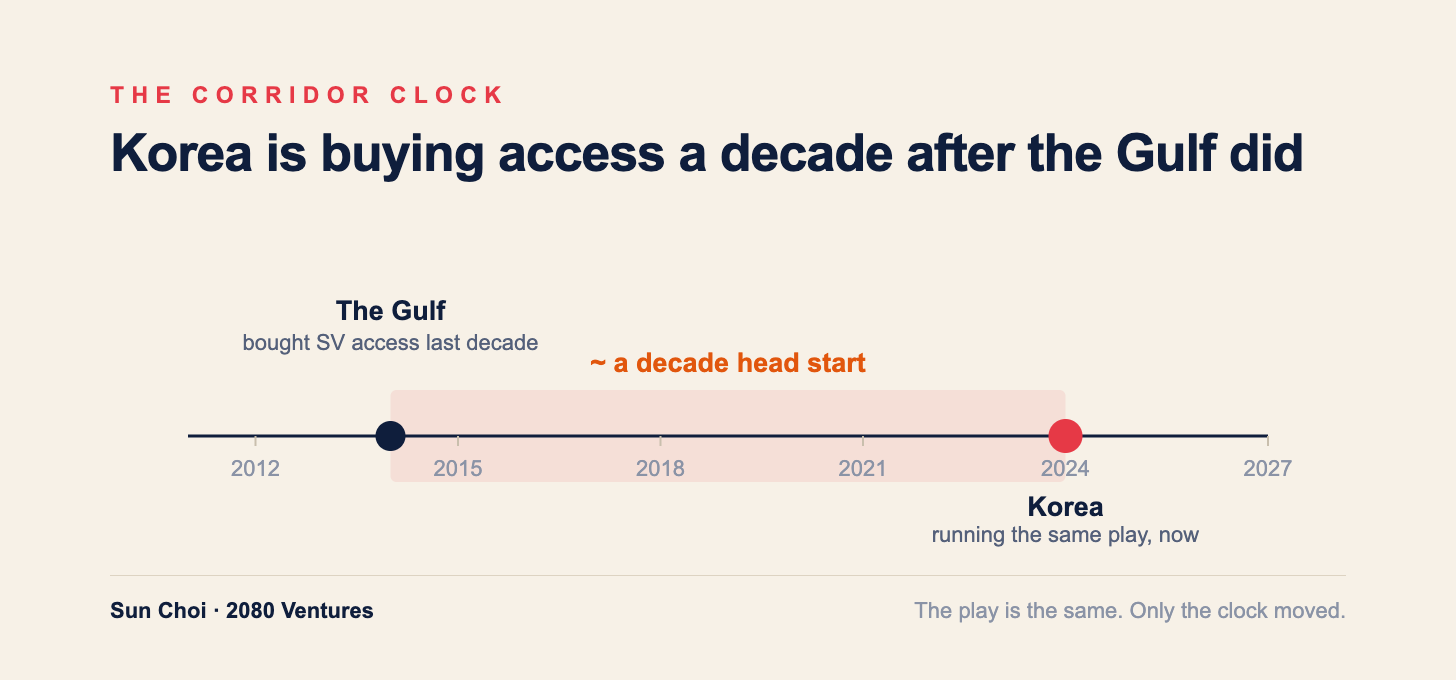
Gulf sovereign capital started buying its way into Silicon Valley access more than a decade ago. Direct stakes, anchor LP positions, co-investment seats. Not because the Gulf lacked capital. Because capital without access is just a balance sheet entry.
Korea is running the same play now, a decade late. That gap is not a criticism of NPS. It is the whole thesis of the corridor I sit in.
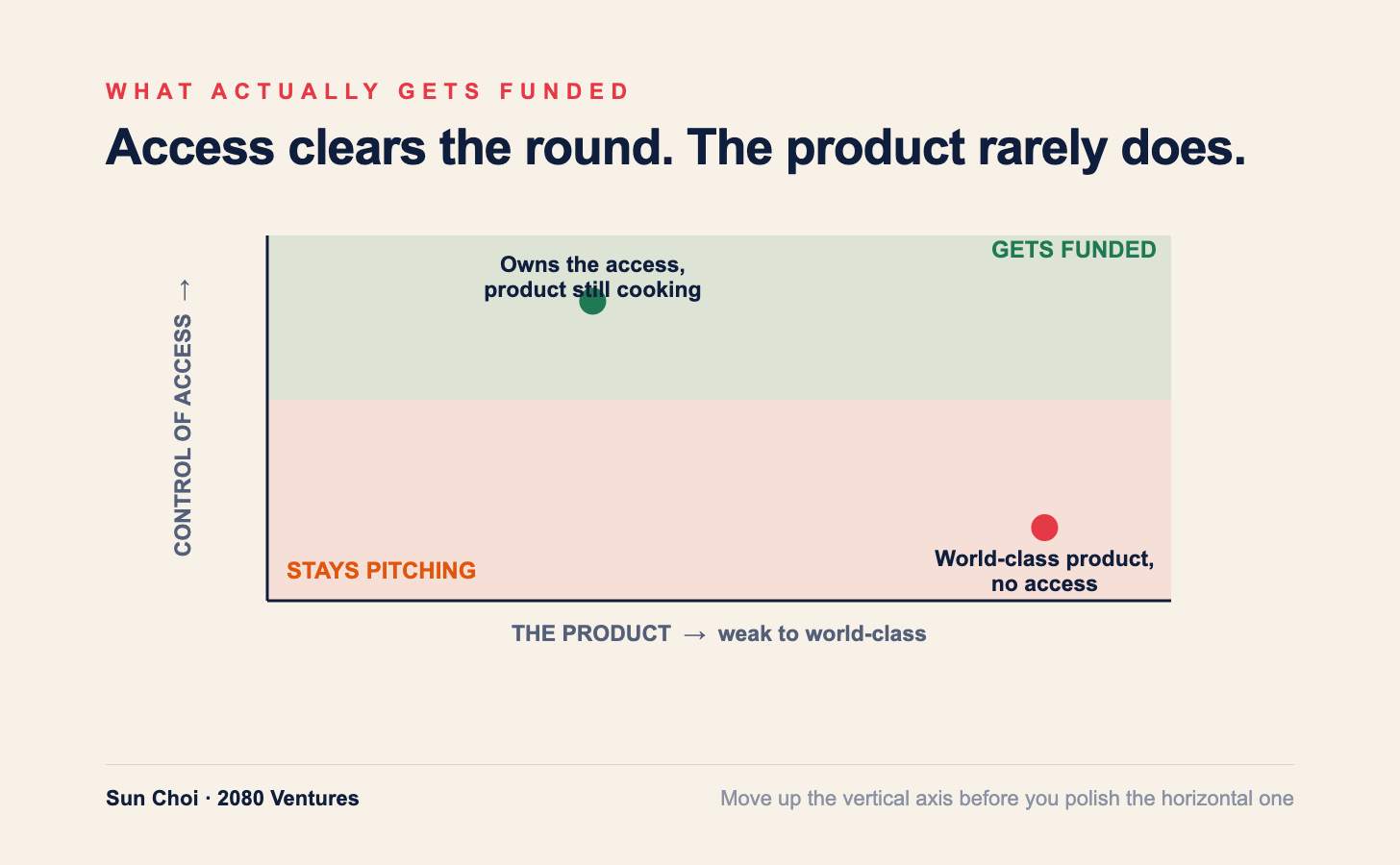
Access is not a byproduct of capital. It is a separate asset, priced separately, and most allocators only discover this after they have already spent years building the wrong kind of scale.
The operators who saw this early in the Gulf are the ones sitting on the cap tables that matter today. The ones who see it in Korea now are the ones who will sit on the next ones.
Whoever reads the structure first gets the next seat
Here is the part LPs underprice. When a government fund-of-funds makes its first commitment into a new structure, that commitment is not just capital deployed. It sets the benchmark price for every commitment that follows.
Once the first check clears, the terms are the terms. Later LPs are not negotiating from zero. They are negotiating against a number someone else already set, usually without meaning to.
The first commit isn't an investment decision. It's a pricing event. Everyone who shows up after is reacting to it, whether they know it or not.
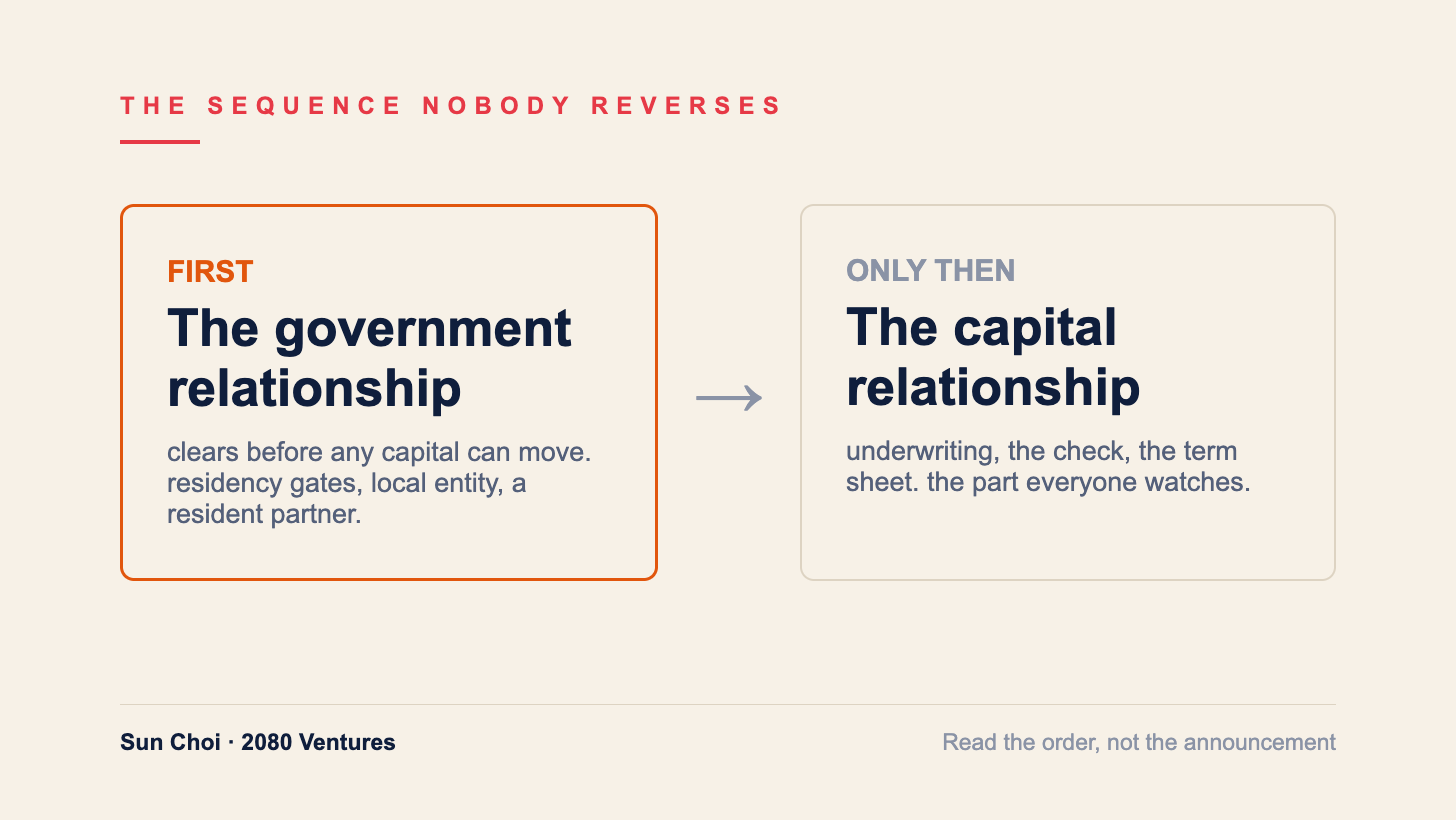
This is exactly the dynamic playing out in government-backed PPP structures across the Gulf right now: whoever anchors the SPC first sets the credibility bar the rest of the syndicate has to clear. Small partners who wait for the "right moment" to negotiate their position are negotiating against a benchmark that no longer exists.
The corridor lesson is not "move fast." It is read the structure before it locks, because the structure locks faster than the fundraise does.
When equity gets crowded, the smart money changes instruments
GCC founders are increasingly walking away from equity rounds and taking private debt instead. Not because debt is cheaper. Because the equity valuation game in that market has gotten tired, priced by comps that no longer reflect what these companies are actually worth, and founders are done playing a game where the number is decided by everyone except them. Private debt in the Gulf hit $4.1 billion last year and overtook venture capital for the first time.
This is a corridor signal, not a GCC-only one. Every emerging market venture ecosystem eventually hits the point where equity pricing becomes theater and debt becomes the honest instrument. Korea has not hit that point yet. Central Asia is not close. But the Gulf just showed the whole corridor what it looks like when founders route around a broken pricing mechanism.
The winners in the next 18 months will not be the funds still fighting over equity terms.
They will be the debt providers who show up early, before the category gets crowded and the pricing gets efficient again.
Whoever locks in as lender-of-choice first is the one who gets called first next cycle. Same dynamic as the fund-of-funds benchmark. Different instrument.
More funds means more noise, and noise is a business
The number of emerging market fund managers keeps growing. Good for founders, in theory. Expensive for LPs, in practice. Every new fund is another diligence cycle, another set of references to chase, another track record to verify with incomplete data.
That cost does not disappear. Somebody absorbs it. And whoever builds the credibility layer that absorbs it, whoever LPs trust to have already done the filtering, becomes the next generation's gatekeeper. Not by raising the biggest fund. By making the sorting cost go away for the people who write the checks.
This is the same access thesis as NPS-Silicon Valley, just running one layer down. Access to deals is scarce. Access to *trustworthy filtering of deals* is scarcer.
The banker beats the app, at least for now
Zoom into Uzbekistan and the same thesis shows up at street level. Islamic finance is only now rolling out there, and the banks building it are not betting the whole game on the app. They are leaning on "mahalla" bankers, neighborhood-level relationships, one district at a time.
Western fintech investors keep assuming emerging markets leapfrog straight to digital, skip the branch, skip the human. That assumption is wrong here. Digital trust and in-person trust are scaling side by side, not in sequence. The neighborhood banker is not a legacy cost center being phased out. In a market where trust is the actual product, the human is the distribution channel, and the app is just the receipt.
That is the same lesson as everything above it, just harder to see because it looks small. Access is never only institutional. It is retail too, one relationship at a time, and the operators who only look at the app store rankings will miss where the real trust is actually being built.
The thread
None of these five stories are really about pension funds, private debt, fund managers, or banking apps. They are all the same story told in five markets: the instrument is never the moat. The access is.
Korea is buying access it should have built a decade ago. The Gulf is monetizing the access it built back then, twice over, once through equity and now through debt. Emerging fund managers are multiplying faster than LPs can filter them. And in Tashkent, the oldest access channel in banking, a person who knows your neighborhood, is still outcompeting the app.
If you're allocating across this corridor, the question worth asking isn't which instrument to use. It's who already controls the door you're trying to walk through.
More of this every week if the corridor thesis is useful to you. Subscribe below.