Last month, I watched a Korean AI startup lose a $3M Silicon Valley round.
Not because their pitch was weak.
Not because their metrics were bad.
Because their first angel investor—who invested $50K two years ago—quietly told three different VCs:
“Yeah, I’m just concerned about how this US round affects our terms.”
That one sentence killed six months of work.
The founder never knew it happened.
I call this the “Silent Blocker” effect.
Your existing investors don’t say “don’t raise abroad.”
They just make it impossible—quietly.
After facilitating 100+ cross-border rounds across Asia, MENA, and the US, I’ve seen more deals die from cap table politics than bad pitches.
Here’s the alignment system that prevents these invisible wars.
Why This Is Happening More Now
We’re in a market where “Seed” is no longer one clean round.
A growing share of seed-stage activity is bridge rounds and extensions. Carta reported that 42% of seed-stage investments were bridge rounds in Q1 2024. Axios (citing Carta) shows the trend: 31% in 2022, 39% in 2024, and 46% in Q1 2025.
That stretch creates more situations where:
You need more capital before Series A, and
You consider raising in a different geography
Which makes alignment even more critical.
The Real Enemy: Misalignment, Not Valuation
Your existing investors (angels, funds, strategics—anyone already on your cap table) usually worry about four things:
1. Dilution without upside - They get watered down but can’t participate
2. Losing access - They hear updates late, if ever
3. Round control - They fear weird terms from a new lead
4. Narrative risk - “Does this mean we’re stuck?”
If you don’t address these, the round turns into a slow-motion war.
Not open conflict. Silent resistance.
The Three Types of Silent Blockers
Most founders fear loud critics. They should be terrified of silent killers.
👻 Type 1: The Ghost
You ask for US investor intros
They say “sure, let me think about who fits”
Week 2: “Still working on it”
Week 6: Radio silence
🌡️ Type 2: The Lukewarm Reference
New lead calls for reference
They say: “Good team... but you know, tough market”
Not negative enough to be obvious sabotage
Just enough doubt to make the lead pass
💣 Type 3: The Term Sheet Terrorist
You get a term sheet from new lead
Your existing investor suddenly discovers “concerns”:
“This valuation seems aggressive”
“These pro-rata terms don’t work”
“We need to renegotiate our rights first”
Round dies in legal limbo
The pattern? They never explicitly object. They just make success impossible.
Visual 1: Silent Blocker Risk Matrix
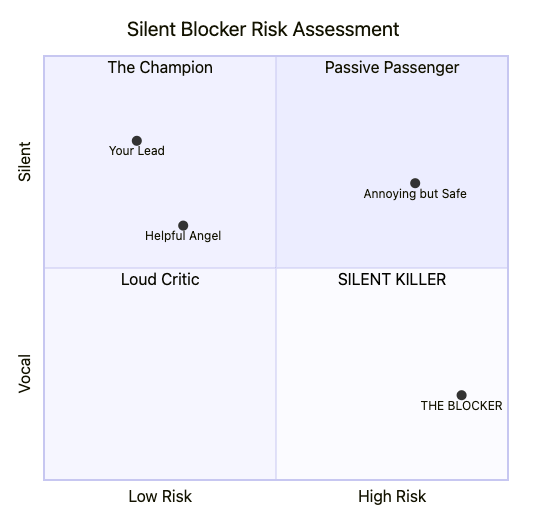
Most founders fear the Loud Critics. They should be terrified of the Silent Killers.
Case Study: The $5M Round That Died (Then Lived)
Company: B2B SaaS, Series A stage targeting US expansion
❌ First Attempt (Failed):
Didn’t align Korean seed investors before US outreach
Angels heard about US plans through mutual connections
Felt “replaced” → stopped making intros
One angel had aggressive pro-rata → threatened to block
Result: 6 months wasted, $0 raised
✅ Second Attempt (Success):
15-minute alignment calls with all major holders
Offered SPV for Korean angels to participate
Weekly updates during US fundraising process
Pre-negotiated pro-rata with problem investor
Result: $5M closed in 8 weeks
The difference: Same founder, same metrics, same pitch. Different alignment strategy.
The Cap Table Peace Plan (5 Moves)
Critical: You must follow this exact order. Most founders do Step 5 first—that’s how they create silent blockers.
Visual 2: The Right Way vs Wrong Way
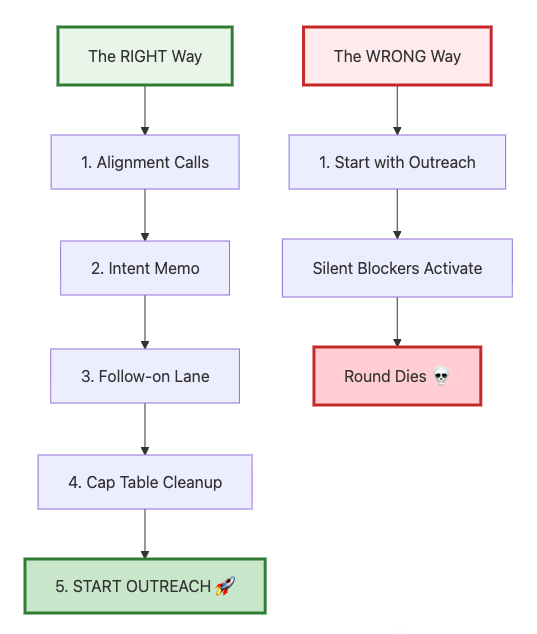
The order matters. Skip alignment and you create silent blockers.
Move 1: Alignment Call (15 minutes each)
Before you pitch new investors, align your current major holders.
Goal: Surface objections early, while it’s still cheap to fix.
You’re not asking for permission. You’re preventing surprises.
Your script:
“Here’s what we’re planning.”
“Here’s why now.”
“Here’s what I’m worried you might worry about.”
“Tell me what would make you comfortable.”
Founders skip this because it feels awkward.
It’s awkward for 15 minutes… or painful for 6 months.
Move 2: Round Intent Memo (One Page Only)
Not a deck. A 1-pager.
If you can’t explain the round in one page, you’re not ready.
Round Intent Memo Template:
Why now: What changed since the last raise (proof upgrades)
Use of funds: 2–3 concrete outcomes (customers, distribution, hires)
What this is NOT: Not a reset, not panic
Timeline: When you want to close
What you need from them: Intros + references + (optional) follow-on
This one page becomes your internal constitution. Without it, everyone creates their own story.
Move 3: Follow-on Lane (So No One Feels Left Behind)
Most conflict disappears when investors have a path.
Offer a clear lane:
Direct follow-on participation, or
SPV / sidecar option, or
A clear explanation why follow-on isn’t needed (rare, but possible)
The point isn’t money. The point is psychology:
No one likes being diluted while watching from outside the room.
Move 4: Cap Table Cleanup (Before New Leads See It)
Cross-border rounds die in diligence because of hidden mess.
Clean the common killers:
Multiple SAFEs with different caps or MFNs
Forgotten side letters
Aggressive pro-rata rights that scare new leads
Unclear option pool math
IP assignment / jurisdiction confusion
You don’t need perfection. You need legibility.
If your cap table looks like a junk drawer, new leads assume the company is run the same way.
Move 5: Start Outreach (Only After 1–4)
Most founders do this first. That’s how they create silent blockers.
When you align first:
Intros flow faster
Reference calls go smoothly
Terms negotiations get simpler
Diligence becomes predictable
When you don’t:
You’ll spend months repairing trust while you’re also trying to sell a story to new investors
That double load is what breaks teams
Visual 3: The 5-Step Process Flow

The complete alignment-first fundraising system.
“What If My Earliest Investor Is Already From the US?”
Then this is even more important.
Because your risk is not “US vs local.” Your risk is existing vs new.
Even US investors can become blockers if:
They fear new terms that harm them
They feel you’re running a process without them
They suspect the round is reactive, not planned
This isn’t about nationality. It’s about cap table dynamics.
Copy-Paste Templates
📧 Email to Existing Investors
Subject: Quick alignment before we start [region] fundraising
Hi [Name] — quick heads up before we start outreach.
We’re planning a [Bridge / Extension / Seed II / Pre-A] round to fund:
[Outcome #1 — e.g., “Hire 3 engineers for US expansion”]
[Outcome #2 — e.g., “Reach $50K MRR in North America”]
[Outcome #3 — optional]
This is a continuation, not a reset.
Here’s a one-page memo with timeline + plan: [link]
Two quick asks:
Any intros to investors/operators in [region] who match [profile]?
If you’d like a follow-on lane (direct / SPV / sidecar), tell me what’s easiest on your side.
Can we do a 15-minute sync this week so there are no surprises?
Thanks,
[Your Name]
💬 Investor Ask Message (For Intros)
I’m raising a [round type] to fund [2 concrete outcomes] over [X months].
We’re looking for [investor profile].
If you know 2–3 people who fit, I’d appreciate a warm intro.
I’ll keep it tight and respectful of their time.
The Takeaway
Cross-border fundraising is not “a better pitch.”
It’s a better alignment system.
If you align your current cap table first, fundraising gets faster.
If you skip it, you’ll spend months fighting invisible resistance.
What’s Next
If you’re planning a cross-border round in the next 6 months:
This week:
List every investor who could become a silent blocker
Draft your Round Intent Memo (use template above)
Schedule 15-min alignment calls
Don’t wait for a term sheet. By then it’s too late.
Two ways I can help:
Free: Get my “Cross-Border Fundraising Red Flags Checklist” →
For serious founders: Monthly cross-border deal breakdowns with real numbers, cap table templates, and quarterly fundraising office hours →
One question: What’s your biggest silent blocker risk right now?
Hit reply—I read everything and often turn common questions into future posts.
Data sources:
Carta — seed-stage bridge rounds share (Q1 2024)
Axios — citing Carta: seed bridge rounds share (2022, 2024, Q1 2025)
Sun Choi
Founding Partner, 2080 Ventures
Cross-Border Architect